Chartplotters in the cockpit have made navigation much less tiring. In the era before modern electronics, when everything had to be done at the chart table, it was tough going up and down regularly to write log entries, update our chart position and – in far distant days – take a bearing with a nausea-inducing radio direction finder. In rough weather and at night it quickly became seriously exhausting.
A great energy saver arrived when we first put a chartplotter in the cockpit, so we were not obliged to struggle down to the chart table and back again every time the log had to be entered or the chart checked. If the weather and sea are making us work hard, we keep a deck log instead in a notebook and enter it later.
But we’re out of date. The reliable though ancient Standard Horizon chartplotter, mounted in front of the wheel, has complex buttons and a tiny screen which makes it difficult to read charts with tired eyes, especially at night, and it’s tricky to programme quickly with revised routes while at sea.
More problematic still, its charts can no longer be updated. So we are about to fit a modern Raymarine Element 7S chartplotter to replace our reliable but ancient Standard Horizon plotter. The new one has a modest 7 inch screen, but that’s big enough, because it will be at eye level immediately in front of and above the wheel.
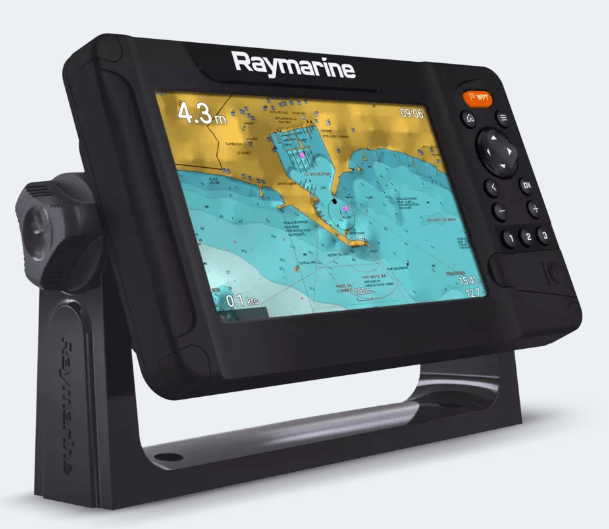
We deliberately avoided the fancy touch screen models that they sell most of nowadays. The feedback we got from users on line and in conversation was that if you sail in an open cockpit in wet and windy places, a touch screen is the last thing you want: even the allegedly improved recent versions behave eccentrically when they’re wet.
Element also happens to be Raymarine’s cheapest range, marketed more to amateur fishermen than to yachts. A dealer we spoke to said simple button-controlled devices like Element and other equivalents remained the best bet for sailing yachts with open cockpits, even though they were mainly marketed to fishermen as fishfinders.
There are also models with both touch screen and button control, but they are twice as expensive – and three times the price we eventually paid Force Four chandlery in a sale for our ex-display Raymarine.
The Element and the pricier touch screen models are all Multi-Function Displays (MFD). Even ours at the cheap end will show AIS, radar, depth, wind, log and engine and fishfinder data on split screens. Of those, we only want AIS signals showing ship location.
There is no way of connecting our ancient radar, the other instruments would probably have to be upgraded if we wanted to integrate them, there’s no point in having a fishfinder, and the engine control panel would have to be renewed to make it talk to an MFD.
We have a Digital Yacht AIS transponder from 2010 which still works well, broadcasting our course details on VHF as well as receiving ship positions, course and other data. It uses an old communications standard called NMEA 0183.
To link it to the new plotter we bought a Digital Yacht device called iKonvert which changes the signal to the modern NMEA 2000 standard. We also bought the simplest possible Digital Yacht starter kit for the highly specialised cabling and connectors needed for NMEA 2000. The total cost was well under £300 against a starting price of about £750, plus the cabling kit, for a new AIS.
For £5, we’re raising the AIS aerial 2 metres above the rail where it is now, by strapping a length of grey plastic plumbing pipe to the pushpit rails behind the helm, rather than the pricey stainless steel tube that’s often favoured. That will increase the range at which we receive ship positions.
Our old plotter was mounted flush on a glass fibre pod immediately forward of the wheel. We’ll make the new one removable by putting it on a Raymarine bracket fixed to the old pod. It can be easily released from the bracket.
That way it can be protected down below when we’re not on board and taken home in the winter to update and add routes. The old plotter has been fixed solidly in the cockpit ever since it was bought.
Chartplotter backups
We’re old fashioned – we don’t like the idea of having all our navigation instruments linked together in one display. We like lots of redundancy, as they say in the systems world – if one device goes down, we want multiple independent backups.
We also have two tablet chartplotters. One is an 8 inch waterproof, shockproof and sunlight-readable Samsung Active 2 T-395, which can be used in the cockpit; the other is a 10.5 inch Samsung tablet mounted at the chart table.
If things really get difficult, we have mobile phones on board with the Navionics chart app loaded, and it’s perfectly possible to do basic navigation with either of them. Navionics subscriptions can be used on multiple devices. If the boat’s batteries fail, we have several spare rechargeable batteries for the tablets and phones, including a large dual purpose one which can be used as a jump starter for the engine when the main batteries are flat or for topping up tablets and phones.
Charts
We have slashed the number of paper charts on board, which is why we focus so much on backups for our electronic charts. Reliability of electronics will become increasingly important because the UKHO is set to phase out all Admiralty paper chart production from 2030 (delayed from 2026 after protests). Only Imray has promised to carry on publishing paper charts.
A full set to go round Britain in the old days could involve a hundred or more Admiralty paper charts, because lots of inshore detail is needed (there are 850 for the whole of the UK and Ireland). On both Round Britains in 2007-8 and 2012-13 we did not want the cost of a full set of paper charts, and even less did we want to spend the time required to update them.
Instead we relied on our chartplotter plus Imray paper charts for yachts, which cover long stretches of coast, with detailed insets showing ports and estuaries. There are, for example, only 7 needed between Harwich and Oban, which is half the round-Britain distance.
On the first round Britain we were chancing it a bit, because we did not have tablet or phone back up to the plotter, even though we had the bare minimum of paper charts. The second time we took a laptop as backup, but that’s cumbersome and needed a lot of power to charge from a 12 V boat system.
Nowadays, we are much more serious about electronic backups. Yes, a lightning strike could knock it all out – but hopefully we will have remembered in time to put one of the tablets in the oven! Steel all around shields from high voltage.
Our old plotter used C-Map vector charts, which are good, with lots of extra information beyond the basic chart data, accessible by clicking on chart features. This is the basic advantage of the vector type, which are also multi-layered and show more detail as you go deeper. C-Map is good but Navionics vector charts are cheaper, more flexible when used on tablets, and much easier to update, so we have switched to those.
We have reservations about Navionics accuracy from past experience. So it is reassuring to add multiple electronic chart brands, each with their own advantages, so we can crosscheck.

On the tablets we have the Memory Map app with Admiralty-based charts – the gold standard – loaded for the whole of the UK and Ireland, all 850 of them. They are the raster type, which look exactly like paper charts. They show detailed hydrographic survey information in their notes sections. That gives an indication of chart reliability which is missing on vector charts for leisure users. Unlike vector charts, raster charts do not show more detail as you enlarge them.
Both the tablets also have the wonderfully detailed Antares charts of anchorages on the West Coast of Scotland, produced by Bob Bradfield, which make up for the serious deficiencies of all other charts close inshore in Scotland, including the official Admiralty ones.
Finally, the cockpit tablet has an excellent app called Marine Navigator, with the 850 Admiralty-based charts for the UK and Ireland supplied online by VMH of Cowes. It is a more clearly presented version of Admiralty charts than Memory Map, and the Marine Navigator app has much better navigation functions. Antares does not work as well as on Memory Map, but we have loaded it nonetheless. We will have Navionics, Admiralty and Antares available on both tablets.
Memory Map, Antares and VMH charts and their apps are a small fraction of the price of buying Navionics and other brands for a full-function chartplotter. At £60 the lot, it’s no great financial burden to add them all as backup. The waterproof tablet, the Samsung Active2, cost £75 second hand on backmarket.co.uk. The other Samsung is a second-hand 10.5-inch model bought two years ago for £125 from Backmarket.
There is one advantage of Navionics that is new for us: we can load routes from the tablets or the phones to the chartplotter and vice versa, so we can follow the route both at the wheel and at the chart table. Routes are prepared in advance on the tablet and copied onto the plotter.
They are first saved as GPX files onto the tablet’s SD card. (GPX is a type of file widely used in land mapping). The chart card on the plotter is removed, the SD card is inserted in its place and the GPX files saved to the plotter’s memory. The SD card then goes back to the tablet, and the Navionics chart card is reinserted in the plotter. Transferring routes to the tablet from the plotter reverses the process.
Raymarine’s own chart brand, Lighthouse, allows direct transfer of GPX files from tablet to plotter using a local wifi generated by the plotter, and more expensive plotters – way beyond our budget – will mirror their screens directly to a tablet. We prefer Navionics, because it is so flexible on tablets and phones, even if it is restricted to SD card transfers.
While we were thinking electronics, we also bought a new Nasa Navtex weather receiver, this time one with an improved aerial, and without a screen. Instead it can be read on a phone using bluetooth.
 tide by tide