Years before the inner London docks closed towards the end of the 1960s, a few of us from school started exploring what was then a strange and forbidding area with a hint of danger and adventure, a world alien to the genteel suburbs where we were brought up.
I had passed my driving test at 17, and a year later in 1961 I bought an ancient pre-war Austin, black outside, dark brown inside, its smell a mixture of engine oil and old leather from the worn seats. The car was big enough to cram in 5 or 6 of us.
Somebody tipped us off about a pub called the Prospect of Whitby in Wapping, which had begun to attract customers from further afield than the docks, because of its attractive frontage overlooking what was then a proper working river.
The inner London docks were declining rapidly, but there were still cargo ships steaming up to and through a raised Tower Bridge to the Pool of London, where they were unloaded by old-fashioned jib cranes; at the wharves, stevedores milled around deep in the holds, or handled loads in the grimy warehouses that lined both sides of the Pool between London Bridge and Tower Bridge.
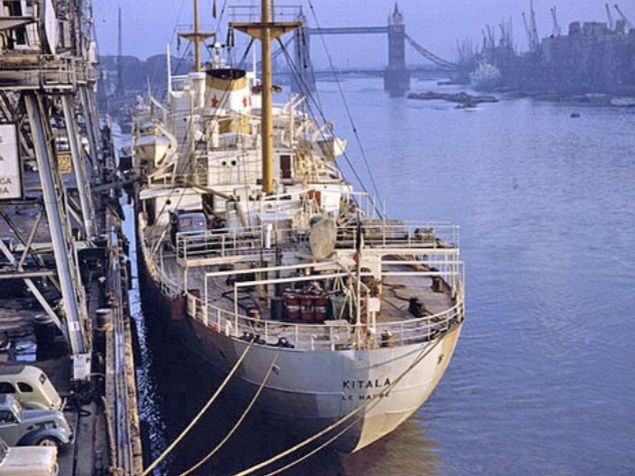
After the first excitement of the Prospect of Whitby, we began to look for other pubs among the docks, down as far the eastern side of the Isle of Dogs, where the West India Docks were struggling with declining numbers of merchant ships until they finally closed in 1980.
Driving through, it looked a broken wasteland, from the Royal Mint near St Katherine’s Dock to the far side of the Isle of Dogs and beyond. It was gloomy in the brightest sunlight; high security walls were everywhere, bright yellow London brick when new in the 19th century, so corrupted by a century of coal smoke that they had become almost black. There were great iron studded gates in the dock walls, and a dank smell of unclean water, oil and waste all around us, out of sight, as we drove down the canyons formed by the cliffs of brick.
As the Victorian docks expanded, so did the thieving and smuggling, because valuable cargoes – furs, food, alcohol and a vast range of goods – were unloaded in small quantities men could handle, making pilfering easier than with today’s containerisation. The result was that fortifications as good as any Norman castle were built around each dock complex.
St Katherine’s Dock by Tower Bridge was decaying so badly when we first saw its bleak exterior that it was chosen a few years later for blitz scenes in the 1969 film Battle of Britain. (Christine and I went there at the time to look around the crumbling walls and brickwork).
The modern tourist redevelopment of the docks has preserved some of St Katherine’s walls and gates, cleaner now, but still looking like the curtain walls of a castle. The 70 years since domestic coal burning was banned have been time enough for rain to improve the brickwork.
Here and there, as we explored further into docklands every few weeks, were run-down dwellings, but also great gaps where the blitz had demolished whole streets and the land was lying fallow, covered in summer in purple rose bay willowherb, which loves to decorate ruins. The river was glimpsed across flattened warehouses or through narrow alleyways leading to landing steps for boats.
Cable Street, scene of a notorious battle in the 1930s between Oswald Moseley’s blackshirts and anti-fascist protesters, was scarred by the war: weak yellow lightbulbs shone at night through thin curtains in scruffy rooms over rundown shops whose windows were unlit. A side door would open briefly and a dark silhouette would slip inside, as we hurried past in the car without stopping, well aware from newspapers that the local businesses were drugs, prostitution and – we feared – robbery of anybody who loitered.
It was perceived as so risky down in the docks in those days that several friends did not dare tell their parents where they were going. Parents would have known from newspaper gossip columns that adventurous royalty had turned exploration of docklands into an outing, a sort of jolly slumming adventure for the upper classes, but those sorts of people were probably well-provided with bodyguards.
In fact, prosperous London found the Prospect of Whitby before we did: in 1961 the pub was well enough known to carry signed photographs of celebrities on its walls. According to the gossip columns and the paparazzi, Princess Margaret and her circle had by then found Limehouse, dining out at a Chinese restaurant in a run-down back street of eating dives. We eventually located it, after royalty had found new places to patronise: the delicious food was a revelation.
The restaurants were part of a Chinatown of seamen’s hostels and missions, laundries, and groceries, exactly where you would expect to find them in a great port city, a short walk from the dock gates through which many of the Chinese would have entered Britain as discharged seamen. China Town in the West End is a much later re-imagination by entrepreneurial Chinese busineses.
As the Prospect of Whitby started its long career as a tourist attraction, we moved further east. By far the nicest pub we found was the Grapes in Limehouse, close to the lock gates through which the Regents Canal reached the Thames. It had a tiny riverside terrace overlooking a beach where Thames lighters were moored. These were big flat bottomed engineless barges that sat on the mud and shingle when the tide was out and creaked and groaned against each other as they rose on the tide twice a day. Once a common sight taking loads from ships to distribute to smaller wharves up river, they were slowly becoming rusty and redundant as the docks closed.
About the same time as our docklands explorations, I had a summer job as a messenger in the shipping and forwarding agency dad ran in Little Trinity Lane, near Queenhithe, the oldest dock in London. Cargoes of Canadian furs were still being delivered by lighters, brought up from ships docked down river from London Bridge, in the Pool and beyond. Men pushed barrows of furs up the steep hill from the river to the vaults of the Hudson’s Bay company near the top of Little Trinity Lane for safe storage. The rank smell of cured skins was unforgettably pungent, and seeped everywhere around the Lane.
Modern versions of lighters can occasionally be seen pulled or pushed by tugs, transporting the city’s rubbish down river. Restored lighters converted to homes or to a bar or restaurant are a common sight further up the Thames or on the Regents Canal or the River Lea.
The Grapes, from which we had a grandstand view of the river traffic, had two small traditional bars on the ground floor built of dark mahogany, ale dispensed by hand pumps, a menu that seemed to be mainly pickled eggs, crisps and pork cracklings, and a fire in a grate in winter. I’ve been going back there from time to time ever since and – unlike the clientele – little in the look of the place has changed. The pub is in a terrace of lovely old riverside buildings, among the earliest in docklands to be converted into expensive homes, one of them for Dr David (Lord) Owen, Labour Foreign Secretary in the 1970s.
For a while The Grapes had a pleasant fish restaurant upstairs, where I entertained contacts when I worked briefly in Canary Wharf nearby, though the space had reverted to bar food last time I went. Downstairs, a pint of prawns, brown bread and butter, a glass of old-fashioned bitter and a view of the river – nowadays with Uber water buses surfing past outside rather than cumbersome lighters riding the tide – make a fine lunch. The physical character of the old Grapes has been perfectly preserved by its current owners, one of whom is the actor Ian McKellen, who starred in Lord of the Rings, and keeps Gandalf’s staff behind the bar.
A few hundred meters from The Grapes, overlooking the modern marina in the old Limehouse Docks, is a new building with a bar where leisure sailors rather than professional watermen gather round to talk about their interests in the sea and the river. It is owned by the Cruising Association, of which I am a member.
In the days when we roamed at night in my old Austin, the favourite place after the Grapes was further down river on the south-eastern edge of the Isle of Dogs. The Watermans Arms was named after the professionals who worked on lighters and small boats.
It had no river frontage, and its attraction in the early 1960s was live music – jazz and blues – and the crowds of fans from all over London. The owner was a TV presenter called Dan Farson, whose American journalist father, Negley Farson, had published a book about his year on a Dutch sailing barge wandering slowly around Sicily, and another book about his adventures motoring a barge across Europe.
We tried a few other places around the docks : in some we could tell as we went in the door that a group of teenagers from another part of London were never going to be comfortable or welcome, so we backed out or drank a quick pint before moving on. (I can’t remember the drink driving rules but it was generally accepted that a driver could safely have a maximum of a couple of pints in an evening without fear of arrest, enough nowadays to get a licence taken away).
We did find one more memorable pub. The Gun was further round the Isle of Dogs from the Watermans Arms, on the waterfront facing east near the ship entrance to the West India docks, which were still working at the time. The landlord had a seaside postcard sense of humour, putting crude jokes on placards and posters on the walls, just about the right level of lewdness and rudeness to be appreciated by 1960s sixth formers.
It was a pub for bitter, crisps, and a view of the river and customers still included dockworkers: the superstructure of cargo ships could be glimpsed here and there above walls, or from the bridge across the lock at the West India dock eastern entrance. I visited a few years ago when The Gun had become an up-market gastropub for Canary Wharf.
We went no further east. The river and docks were hard to approach anywhere in the next stretch, then still well used by commercial shipping. The mouth of the River Lee – Bow Creek – and engineering, timber businesses and scrapyards blocked the way, as well as the ruins of Thames Ironworks, a huge shipyard where a Dreadnought battleship was built before the first world war. Further still down the river, the old Royal Docks, now home to the London Assembly, Excel and London City Airport, were still enclosed and working. So we started exploring south of the river from Rotherhithe to Greenwich. There were some interesting riverside pubs, but they never had quite the same fascination as the wild and undeveloped docklands on the north bank.
 tide by tide