
A visit to Venice brought the chance to learn the basics of rowing all over again. We found there’s almost no relationship between how a Venetian rows and the way we learnt at home.
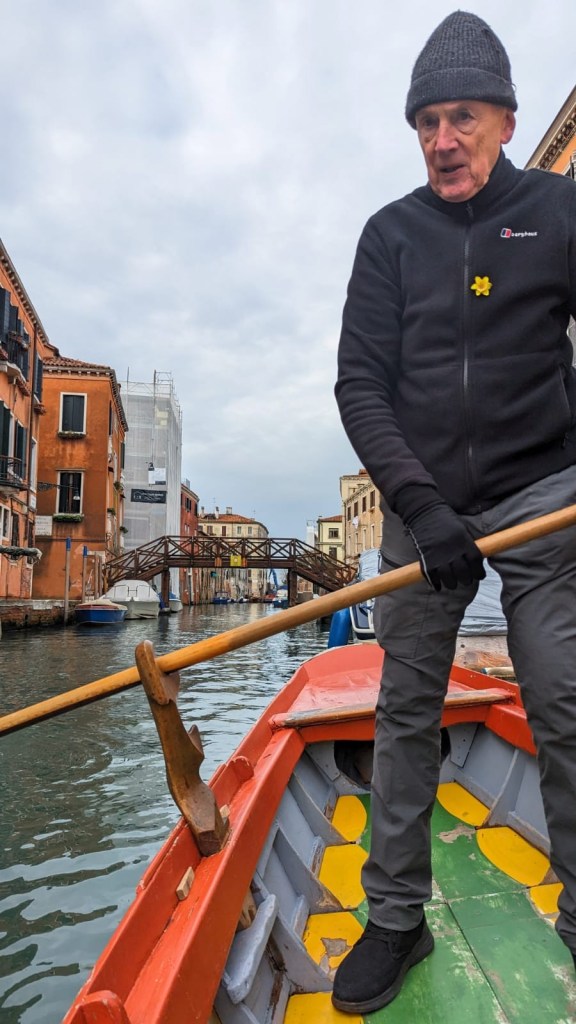
Photo: CMR
You don’t push or pull vigorously, you glide and slide your oar, tipping it gently to steer the boat, with a light touch and a rhythmic motion.
The last thing you should do is strain your muscles as if you’re in a rowing eight at home, trying by sheer force to maximise your speed. Do that and you’re likely to end up in the canal, said our coach, Stefano.
We were first-time learners in a sandolo, a small flat bottom workaday craft, a cousin of a gondola but not a sibling. The most obvious similarity is that you can row and steer both from one side only, holding your oar against a beautifully carved wooden post called a forcola. These have evolved differently for gondolas and sandolos to match variations in the rowing technique required.
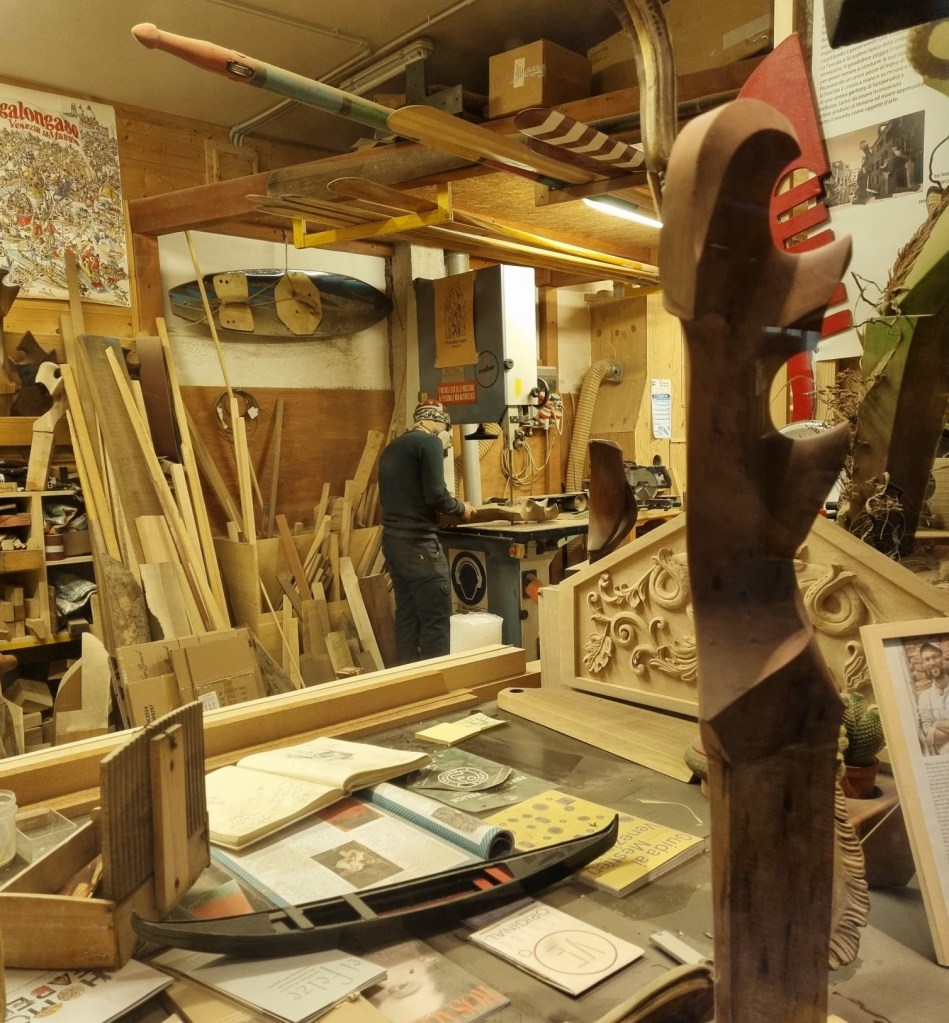
Photo CMR
A gondola is built asymmetrically – deliberately crooked – to counteract the turning motion created by rowing from one side only. The sandolo is symetrical, and the hull shape offers no help in keeping to a straight course. Instead, the only way to keep it on the straight and narrow is by subtle movements of the wrist and arms as you push and pull the single oar back and forth.
We can’t pretend to be knowledgable about the differences, but we’re told that gondola rowing offers some pretty tough challenges. Not least is turning left when the shape of the craft makes it curve its course to the right in order to counteract the turning force of the rower’s strokes. The oar is always on the right hand ie starboard side.
So back to the sandolo. It’s flat bottomed and remarkably stable for a boat of its size. You can stand on the gunwale (I have no idea what the Venetian is for that) of our learner boat and not capsize it.
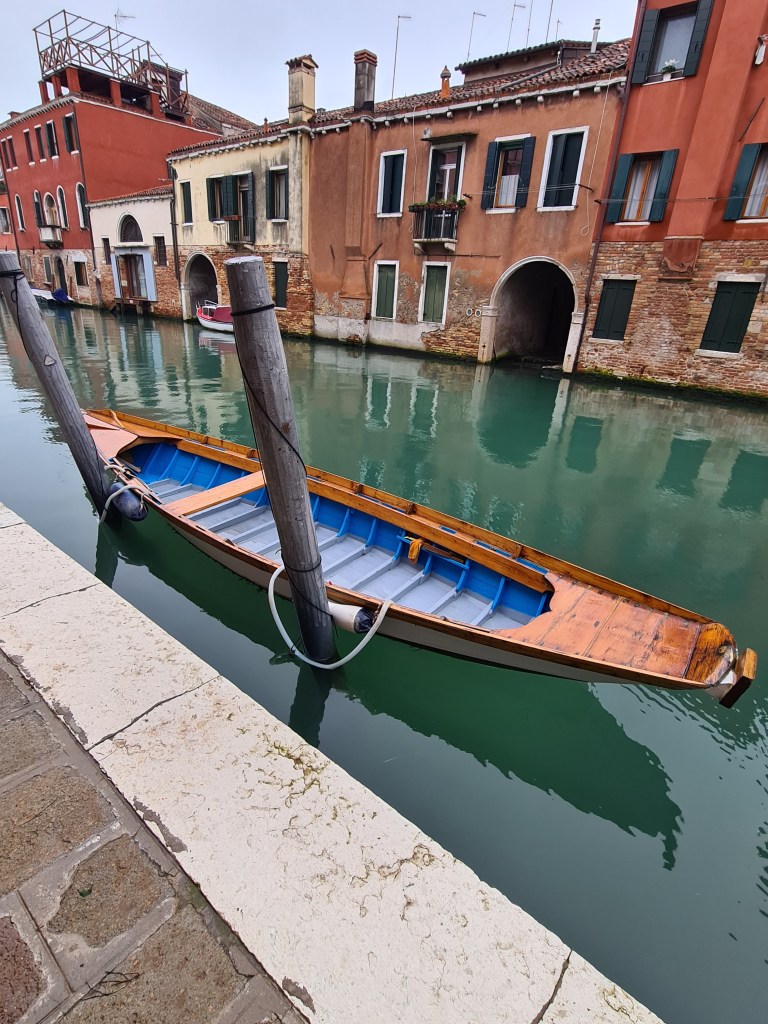
In lesson one, for absolute beginnners, we learnt to stand correctly with feet splayed to give support in two directions. Next, we learnt that the oar should be held lightly with both hands, and that the motion should be a smooth glide, not a hard shove.
First, we move the body and arms forward, pushing the oar blade aft. But the blade must not sit vertically in the water, as we row at home. It should instead be held at a shallow angle, certainly less than 45 degrees to the surface.
The key to the technique is that just before the end of the forward stroke, the oar is rotated by maybe a quarter turn and then, using the body and arms, we ease it back the other way, creating a drag in the water that counteracts the turning motion of the forward stroke.
Another instruction was to incorporate a circular motion of the oar, raising the inner end on the forward stroke so that it digs deeper in the water, and lowering it on the backward stroke.
And finally, we were told to look ahead, not at the oar, and the boat should point all the time slightly to the right of the course you want.
That was quite a lot to digest in one lesson. Sadly, we have to go home, but we’ll be back, and next time we will make sure we have time for a proper course of lessons – and maybe we’ll find out then how to go round canal corners!
Many Venetian boats can be rowed by more than one person, and some have large crews, so there is no single technique that covers everything. Starting with solo rowing makes sense for a beginner because it develops steering skills.
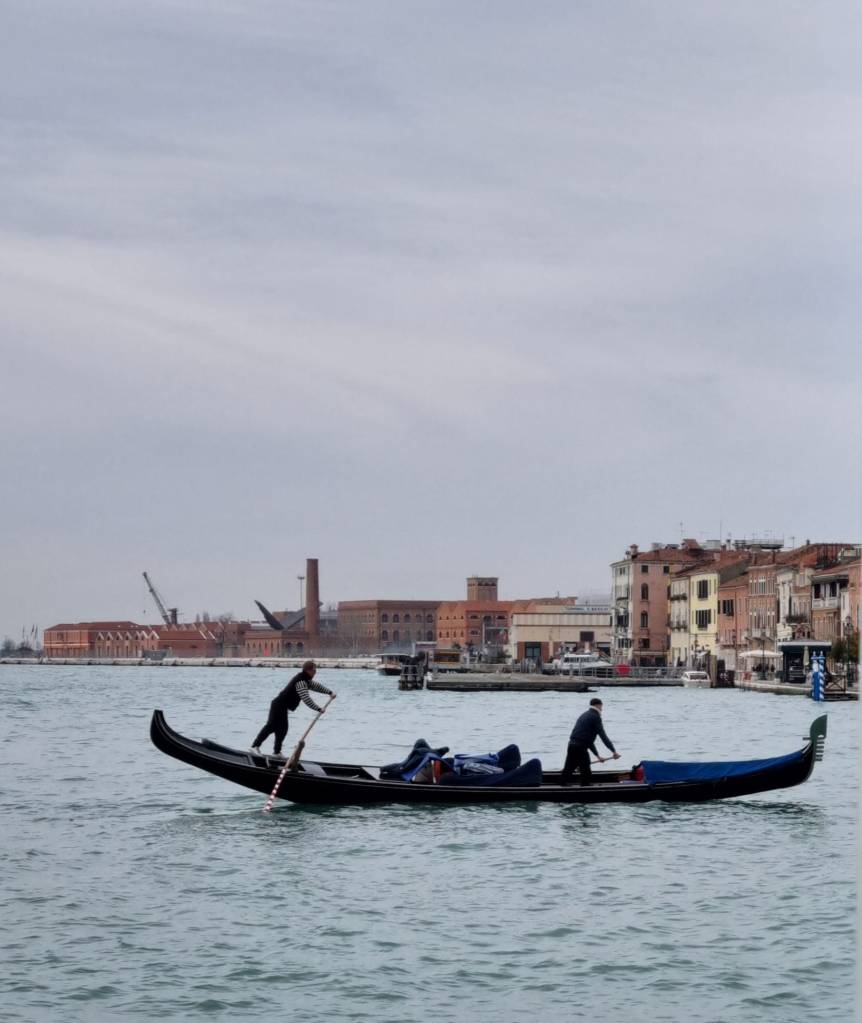
Photo CMR
Our coach, Stefano, was from Venice on Board, https://www.veniceonboard.it/, which is based in the Cannaregio district, tel +39 342 961 0166. Beginners are taught to row single-handed on a quiet section of canal well away from the busy waterways near the Grand Canal.
Another firm offering lessons is this not-for-profit, operated by women rowers. From the website it looks as if teaching is in multi-oared boats rather than the single oar technique described above.
There is, by the way, Venetian rowing in the UK, at Oxford’s City Barge Club. They row their boats on the Thames near Oxford, at least one member is a Venetian expatriate, and they have a joint annual event with a club in Venice.
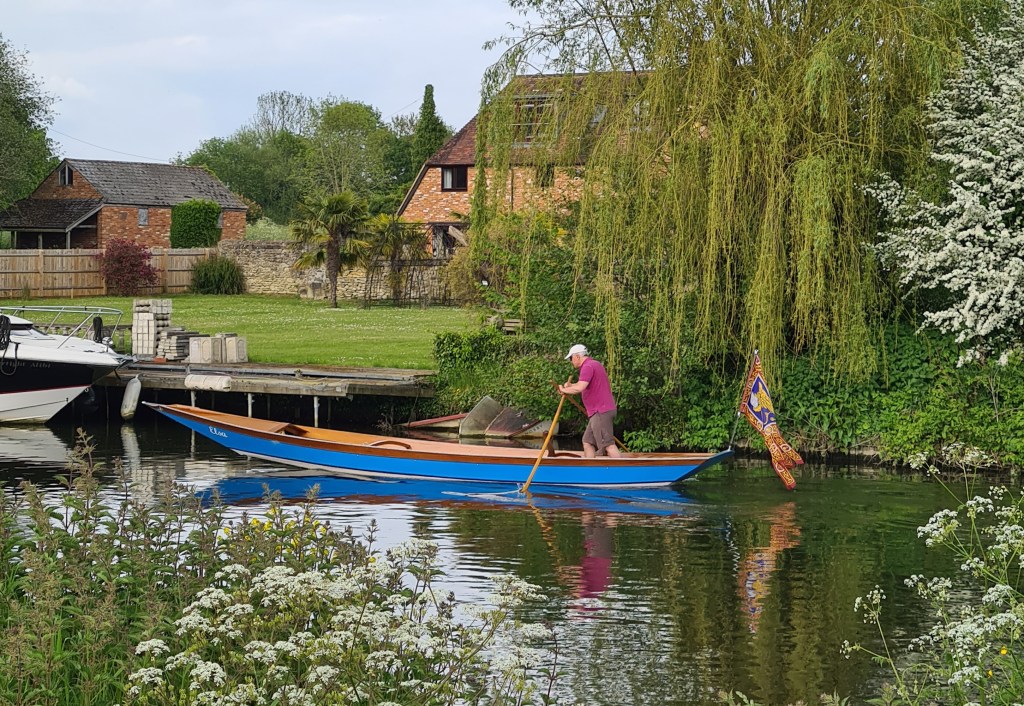
Photo: CMR
PS Note the almost complete absence of lifejackets on the water around Venice. Past experience of exploring the lagoon suggests resistance to lifejackets is deeply embedded in Venice boat culture at all levels. We have seen someone in a kayak wearing a buoyancy aid – but he was flying a tiny red ensign at the stern!
 tide by tide