Is your chart relying on an 1860 survey?

Footnote to cruising the Scillies: piloting there is a reminder of the importance of proper Admiralty charts, because they show the age of the surveys on which they are based, unlike any of the proprietary ‘vector’ charts available on chartplotters.

The Scillies is a mixed area from this point of view. Some of the surveys of the area were last done in 1860 – 1904 by lead line, probably from boats carried on naval survey ships and rowed up and down in straight lines quite a long way apart, so rocks could easily be missed. Other parts of the islands were surveyed at a range of different dates in the 20th century. Continue reading “Is your chart relying on an 1860 survey?”
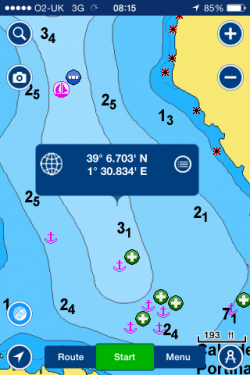
Chart errors (contd).

Several earlier posts covered inaccuracies in charts. Last week I came across yet another example in Cala de Portinax, a bay at the north end of Ibiza in the Balearics. This screen shot from my Navionics chart shows depths in a fair amount of detail: yet the numbers were wrong by a factor of three or four. IMG_2586 Because of the modest depths shown, we motored in with great trepidation in Olivia Jane, a Beneteau 43 with a 2 metre draft. Yet we found the depths in the middle of the bay were all in the 11-13 metre range and even close in to the rocky shore we anchored in 8 metres. In contrast, the C-Map chart on the cockpit plotter gave no depths at all inside the bay, which is a safer option than mistaken information. We’ve fed this back to Navionics and await a reply, but the nagging question will always remain in future, even if this proves to be a rare mistake: can we trust the inshore information on these charts? What if the mistake had been the other way, showing 11 metres when only 2 metres was there? Do other brands of charts have similar errors? Continue reading “Chart errors (contd).”

Marine survey accuracy

Data published by the International Hydrographic Organisation shows up a surprising fact: the UK and Ireland are below Turkey in the league table of survey quality by area of national waters. Spain, Portugal and France score much higher than the UK. Continue reading “Marine survey accuracy”

Med charter disaster?

Since looking into chart accuracy following the Orkney cruise (see previous article) I’ve spent a couple of months in the Mediterranean. It’s much worse there.

I vaguely knew that, but previous sailing in the Mediterranean had been without chartplotters and on the earliest occasions without GPS. More recently, chartplotters seem to be standard on charter boats as well as private yachts. We amused ourselves by doing some checking. Continue reading “Med charter disaster?”

Orkney Roulette

Not long after a jack-up rig called Octopus ran aground in Stronsay Firth in the Orkneys in 2006, we were feeling our way into a bay at nearby Stronsay. We crept through shoals and reefs relying on chartplotter and echo sounder, in strong winds and bad visibility, confident that our plotter would get us through: after all, we had checked it frequently on our passage up the English and Irish coasts and through the Hebrides, and had been pleasantly surprised never to find the GPS positions more than 50 metres out on the chart.

So confident had we become in our first chartplotter that a few days earlier, in fog rolling off the island of Hoy so thick that the boat’s bow was only just visible, we used it, along with the depth sounder, to find our way at dusk into the harbour of Stromness, which involves a tight turn round a reef at a point where the tide can run at up to 8 knots into Scapa Flow, right across the entrance to the inlet leading to the town.

If only we had known more about the quality of the local charts ….. much later, I came across a Marine Accident Investigations Branch report on the grounding of the jack-up rig Octopus, under tow by the tug Harald, which popped up in a web search for something else. (MAIB Report 18 2007).

Continue reading “Orkney Roulette”

How to mimic big ship equipment

To cut back seriously on paper charts, the greater vulnerability of equipment on a small craft to accidental damage would have to be taken into account, including lightning strikes. For small boats it is already possible to buy, at a price, extremely robust electronic systems, including waterproof laptops that withstand impacts (costing several thousand pounds), and high capacity lithium battery back-up packs;  small back-up generators have also become cheaper in recent years and can be accommodated on many mid-sized cruising yachts.

At a cost, robust weather and shockproof  electronic navigation with reliable backup systems should therefore be quite close to achievable now on a yacht. Even if we fall well short of the rigorous standards of an ECDIS system, we will not be carrying 100,000 tonnes of crude oil or thousands of containers, so perhaps we can be allowed to be rather less tough on the backup specifications. Similarly with training: new courses may be necessary, but perhaps not the 40 hours plus specified for ECDIS for commercial ship deck officers.
Continue reading “How to mimic big ship equipment”

Paper-free chart tables

The idea of a paperless chart table is usually dismissed out of hand, and the very suggestion makes some old hands fume. But if a 100,000 ton bulk carrier can now be paperless, then it is hard to maintain that it will always be a mad idea for experienced yacht owners.

Continue reading “Paper-free chart tables”