How to cope without paper charts

UPDATE APRIL 2025

After centuries of printed maritime chart publication in the UK, the options are shrinking rapidly. Until this month it looked as if they would all soon be gone after Imray said it was ending paper chart production – though there is now a reprieve after the announcement of a joint venture with the Austrian cartographers Freytag & Berndt.

Good luck to them, and let’s hope it succeeds. But the precariousness of the paper chart business suggests that a wise owner should still prepare now for entirely electronic navigation.

Luckily small craft can learn a lot from the all-electronic bridges of big ships, which have been paperless for years. That seems to be where we are all headed in the next few years whatever happens to paper charts, which for most people I know are now relegated to passage planning and rarely updated.

I’ve collected and updated material from previous posts in a new note, because events have been moving rather fast.

Here is a link to the note.
RYA navigators still last in the fleet

November 2024 update: This month Imray announced that it is ending paper chart publication at the end of next year, which makes the RYA’s paper focused training look more out of touch than ever. With Imray charts gone and the Admiralty ending paper chart publication in 2030, it will be electronics only in the UK.

Sometimes I wonder where the Royal Yachting Association has been for the last 10 years. I have just had an email from them saying “in the next ten years or so digital will become the dominant method of navigation”. In the real world of small boats, digital has been the dominant method of navigation for at least the last 10 years.

Continue reading “RYA navigators still last in the fleet”

Another Admiralty problem

What I didn’t realise when I wrote the recent post on the UKHO delaying the end of Admiralty paper charts was that there was a sting in the tail – they had wanted to drop raster electronic charts as well. That has also been delayed a few years to 2030 while they think about it.

Continue reading “Another Admiralty problem”

Admiralty gives in

The revolution has been postponed: the United Kingdom Hydrographic Office has delayed the phasing out of its Admiralty paper charts for four years, to 2030. This follows pressure from the Royal Yachting Association and others.

The argument against losing paper charts sooner is that adequate electronic alternatives for small craft – especially small commercial ones – will not be ready in time.

Continue reading “Admiralty gives in”

RYA electronic chart training has missed the boat

The near-universal shift by small boat sailors from paper to electronic charts has left the Royal Yachting Association’s training courses floundering in recent years.

That was underlined when Admiralty, owned by the UK Hydrographic Office and one of the world’s gold standard official chart brands, said in July that it will stop selling paper charts altogether by the end of 2026.

Continue reading “RYA electronic chart training has missed the boat”

May – at last we’ve gone to sea….

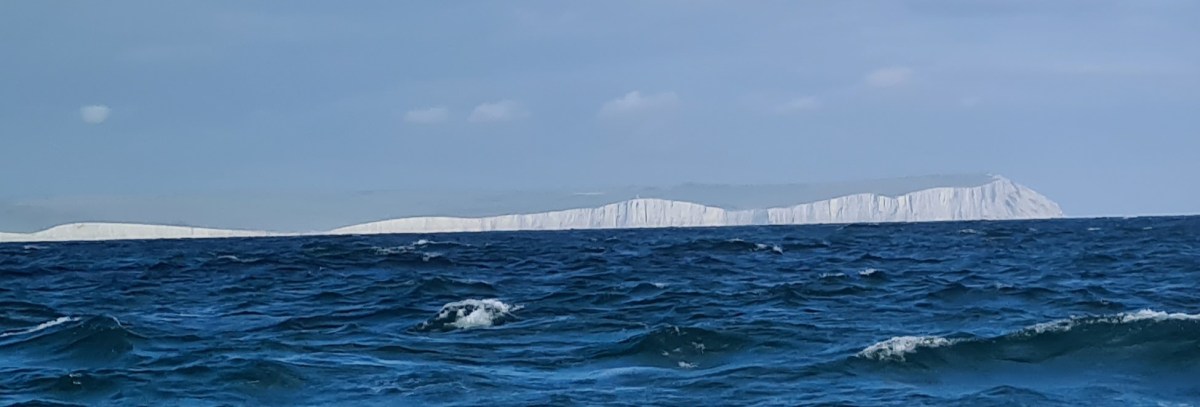
Finally, we got away, covering 180 miles from Cowes to Woolverstone on the Orwell in Suffolk in one go. Conditions were perfect for a fast passage, with Beachy Head crystal clear in the afternoon sun and the white cliffs of Dover actually shining as we passed in the brilliant light of a full moon.

We abandoned plans to stop in Ramsgate when we arrived off the town at dawn with the tide still under us. We kept going, motor sailing with genoa only because there was hardly any wind.

Looking away from the cliffs
Continue reading “May – at last we’ve gone to sea….”

Is your chart relying on an 1860 survey?

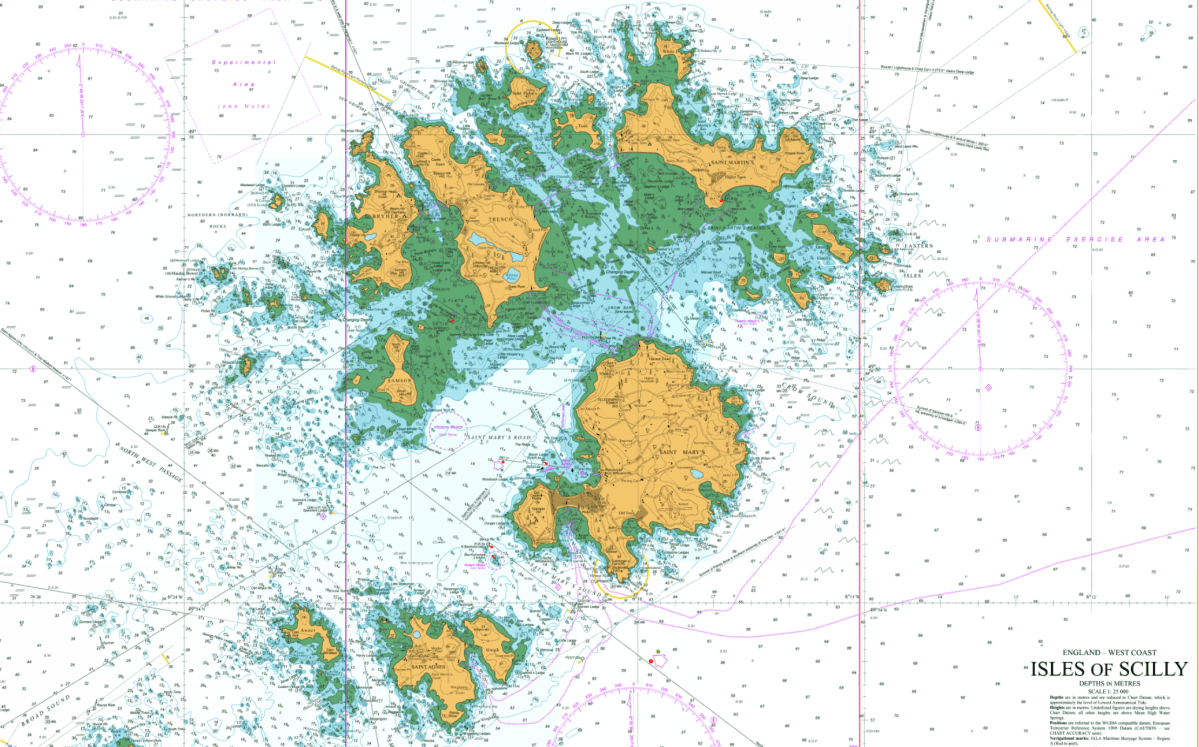
Footnote to cruising the Scillies: piloting there is a reminder of the importance of proper Admiralty charts, because they show the age of the surveys on which they are based, unlike any of the proprietary ‘vector’ charts available on chartplotters.

The Scillies is a mixed area from this point of view. Some of the surveys of the area were last done in 1860 – 1904 by lead line, probably from boats carried on naval survey ships and rowed up and down in straight lines quite a long way apart, so rocks could easily be missed. Other parts of the islands were surveyed at a range of different dates in the 20th century. Continue reading “Is your chart relying on an 1860 survey?”

Marine survey accuracy

Data published by the International Hydrographic Organisation shows up a surprising fact: the UK and Ireland are below Turkey in the league table of survey quality by area of national waters. Spain, Portugal and France score much higher than the UK. Continue reading “Marine survey accuracy”

Orkney Roulette

Not long after a jack-up rig called Octopus ran aground in Stronsay Firth in the Orkneys in 2006, we were feeling our way into a bay at nearby Stronsay. We crept through shoals and reefs relying on chartplotter and echo sounder, in strong winds and bad visibility, confident that our plotter would get us through: after all, we had checked it frequently on our passage up the English and Irish coasts and through the Hebrides, and had been pleasantly surprised never to find the GPS positions more than 50 metres out on the chart.

So confident had we become in our first chartplotter that a few days earlier, in fog rolling off the island of Hoy so thick that the boat’s bow was only just visible, we used it, along with the depth sounder, to find our way at dusk into the harbour of Stromness, which involves a tight turn round a reef at a point where the tide can run at up to 8 knots into Scapa Flow, right across the entrance to the inlet leading to the town.

If only we had known more about the quality of the local charts ….. much later, I came across a Marine Accident Investigations Branch report on the grounding of the jack-up rig Octopus, under tow by the tug Harald, which popped up in a web search for something else. (MAIB Report 18 2007).

Continue reading “Orkney Roulette”

Paper-free chart tables

The idea of a paperless chart table is usually dismissed out of hand, and the very suggestion makes some old hands fume. But if a 100,000 ton bulk carrier can now be paperless, then it is hard to maintain that it will always be a mad idea for experienced yacht owners.

Continue reading “Paper-free chart tables”