Tides of history on the Thames

I’m a member of the excellent Cruising Association, whose headquarters is in Limehouse Dock, a short step from the Thames in east London. 

We have regular winter talks and seminars about yacht cruising. Because of where we are, we have also had some fascinating lectures over the years about the history of our river, and its ancient and modern docks and historic shipyards.

That’s my excuse for putting a link here to a story about docklands and the Thames which I wrote a while back, after I was reminded of the old river by a visit to one of my all-time favourite pubs, The Grapes in Limehouse. It happens to be a couple of minutes walk from the CA.

Prize blog

Pleased to say I won Cruising Association/Practical Boat Owner prize for the best short photographic blog in 2024. The blog was about our cruise from Cowes to Oban via the  Orkney Islands.

A three page extract appears in this month’s Cruising magazine, covering the passages from Pin Mill near Ipswich as far as Wick. Cruising is published quarterly for the CA’s 6,000 members.

The very welcome prize is a year’s subscription to PBO, the magazine that gives less space to test sails of new yachts that no-one I know can afford (I’m referring to Yachting Monthly) and a lot more space to useful information about maintenance and DIY problem solving.

Planning 2025: which islands?

The days are longer, the pilot books have been taken off the shelf, and it’s time to think of this year’s cruise. As a first step in planning, there is nothing better to browse than Hamish Haswell-Smith’s Scottish Islands*.

Haswell-Smith has visited and written about the geology, people and history of every Scottish island, 169 in total by his definition.

The book includes brief mentions of safe anchorages, though not with the essential details of a pilot book or chart. His mission mirrors and complements that of Bob Bradfield, with his personally surveyed Antares Charts of 755 Scottish anchorages.

Haswell-Smith is an excellent preparation ahead of reading up the practical details with our copies of the Clyde Cruising Club pilot books.

With five seasons sailing in Scotland so far, we still have many island omissions, of which the most glaring is the long chain of the Outer Hebrides. We’ve called there only once, mooring for several days a few years ago in the marina at Stornoway on Lewis, where bad weather gave us time to explore by bus before we left for Orkney.

The sensible advice given at the Cruising Association’s excellent Celtic Day meeting in January was that firm plans are a bad idea, given the unpredictability of weather. We’ll decide where to go when we are on board, forecast by forecast, and of course tide by tide.

However, in the right weather, the Outer Hebrides from Mingulay and Barra up to North Uist are where we’d most like to cruise, so that’s what we are reading about at the moment. A secondary objective is to visit the west  coast of Skye.

A gleam in the eyes if we are fortunate enough to have a good weather window is St Kilda, 40 miles west of the Outer Hebrides.

A much less ambitious subsidiary plan is to visit Canna any day of the week from Wednesday through to Monday: when we  arrived last year on a Tuesday we discovered that was the closing day of the much-praised cafe-restaurant.

We have an extra consideration when planning, with neither co-owner in the first flush of youth: creaky joints.

I enjoy the peace of being at anchor. At the seminar I detected  a slightly negative view, which I used to share, of those who seek out marinas, pontoons and official moorings.

However, we do not have an electric windlass, which is quite hard and expensive to fit on an old cruiser racer design. The arm-powered anchor winch is the best we can do. It makes sense not to push our luck and our joints too hard. While anchoring is always an option, buoys and pontoons will also be welcome when we find them.

*The Scottish Islands, Hamish Haswell-Smith, Canongate, £40

Pentland Firth to Orkney

The next leg from Wick to Kirkwall in Orkney required careful preparation, because we needed to cross close to the Eastern end of the notorious Pentland Firth.

This has ferocious tides but, more seriously, is peppered with rocks and deep underwater reefs that create enormous turbulence. Ships, even the navy, are wary of the Firth. In some conditions it can be deadly for  small craft.

We crossed just to the east of the Pentland Skerries
Continue reading “Pentland Firth to Orkney”

June (2) – overnight to Plymouth, fuel consumption

With half a dozen tidal gates on a passage from the Solent round Lands End, we managed to get through four of them in 24 hours last week. The westerlies that usually slow a cruise to Devon and Cornwall gave way to light winds from between north and east, with calm seas.

Tony bringing the boat in from our mooring to Cowes Yacht Haven so I could do a pierhead jump – we’re too mean to pay marina day rates
Continue reading “June (2) – overnight to Plymouth, fuel consumption”

New Brexit chaos for yachts

Just when most yacht owners thought they had understood the impact of Brexit, the government has changed the rules on Value Added Tax, with expensive consequences for some.

Last year there were assurances that, after Brexit, a yacht that has been away from the UK on a long term cruise, typically a few years in the Mediterranean, would not have to pay VAT on returning.

Now it looks as if many will have to pay up, even if the boat was bought VAT-paid in the UK before it left – in other words, owners could find themselves paying VAT twice on the same boat. The second charge would be based on its market value at the time of its return.

Needless to say, cruising yacht forums are full of anger and anxiety, though this is not an issue that will get much sympathy anywhere else because yacht owners are not exactly an under privileged minority.

However, many are far from rich, living aboard on tight budgets for much of the year, often after retirement – ‘fulfilling their dreams’ as the yachting magazines love to put it – a far cry from the superyacht owners everybody hates (who in any case probably arrange their affairs so they do not pay European or UK VAT). And while it is very much a minority problem, how many other much more important parts of the economy are being hit by similar administrative chaos 10 weeks ahead of final departure from the EU?

Both the Royal Yachting Association and the Cruising Association are rather desperately seeking clarity from the government. The Treasury’s position seems to be that under EU rules we already charge VAT on a returning yacht after an absence of more than 3 years. It has decided this will continue to be part of the UK rulebook after Brexit.

But until now the practice has been to suspend the rule in many cases, by exempting private yachts that come back after more than 3 years, as long as they are under the same ownership and have had no substantial upgrades (eg a new engine). In these circumstances, the VAT charge has not been levied. The latest indications are that this concession may go.

Just as alarming for many people, the government has changed the point at which the clock starts on the 3 VAT-free years. Last year the RYA was told that a boat currently kept in an EU-27 country such as France or Greece would be treated as if it had left the UK at the point the UK itself finally leaves the EU ie at the end of the transition period on 31 December 2020. That would give a full 3 years to get back.

Now departure has been redefined as the point at which the boat physically left the UK. Any boat already kept abroad for more than 3 years will be liable to VAT if it returns to the UK after 1 January 2021. This led to howls of protest from the RYA and a promise that there would be an extra year – but no clarity about what that meant.

Would it allow a yacht that has already been abroad more than 3 years another year up to the end of 2021 to come home VAT free? Or would it just add one year to the 3 year grace period, so a yacht that has been away 4 years or less will not pay VAT after 1 January next year, but one that has already been away 4 years and a month will pay?

There’s another set of EU rules that make this even more onerous, if the UK imports them into its own post-Brexit system after we leave, as it seems to be doing with the 3 year rule.

Currently, as long as the importer of a yacht is not an EU resident, the yacht can be temporarily imported for up to 18 months without paying VAT. But if the importer is an EU resident, VAT becomes payable on arrival. (Nationality of the importer and registration country of the yacht are irrelevant – it is the country of tax residence of the importer that matters).

In the past, the UK has taken a tough line on this, with no grace period, though there has been at least one exception among EU countries – Greece in the past certainly allowed a month. If the rule is kept by the UK after Brexit, and applied strictly, it would be risky for a UK resident yacht owner to call in for a day at home in a yacht that has been abroad more than 3 years. The VAT would be chargeable immediately.

The rule seems to be aimed at stopping UK residents keeping their yachts VAT-free in tax havens such as the Channel Islands but using them in the UK – an obvious tax loophole if it were left open.

In fact Spring Fever was first registered in Guernsey in 1988. We have the VAT certificate to prove it was paid when the boat was imported into the UK a few years later, a vital document we guard carefully, especially in these new circumstances. With the first owner on the documentation shown as being a Guernsey resident, we may well be asked to prove VAT has been paid.


Relearning old navigation lessons

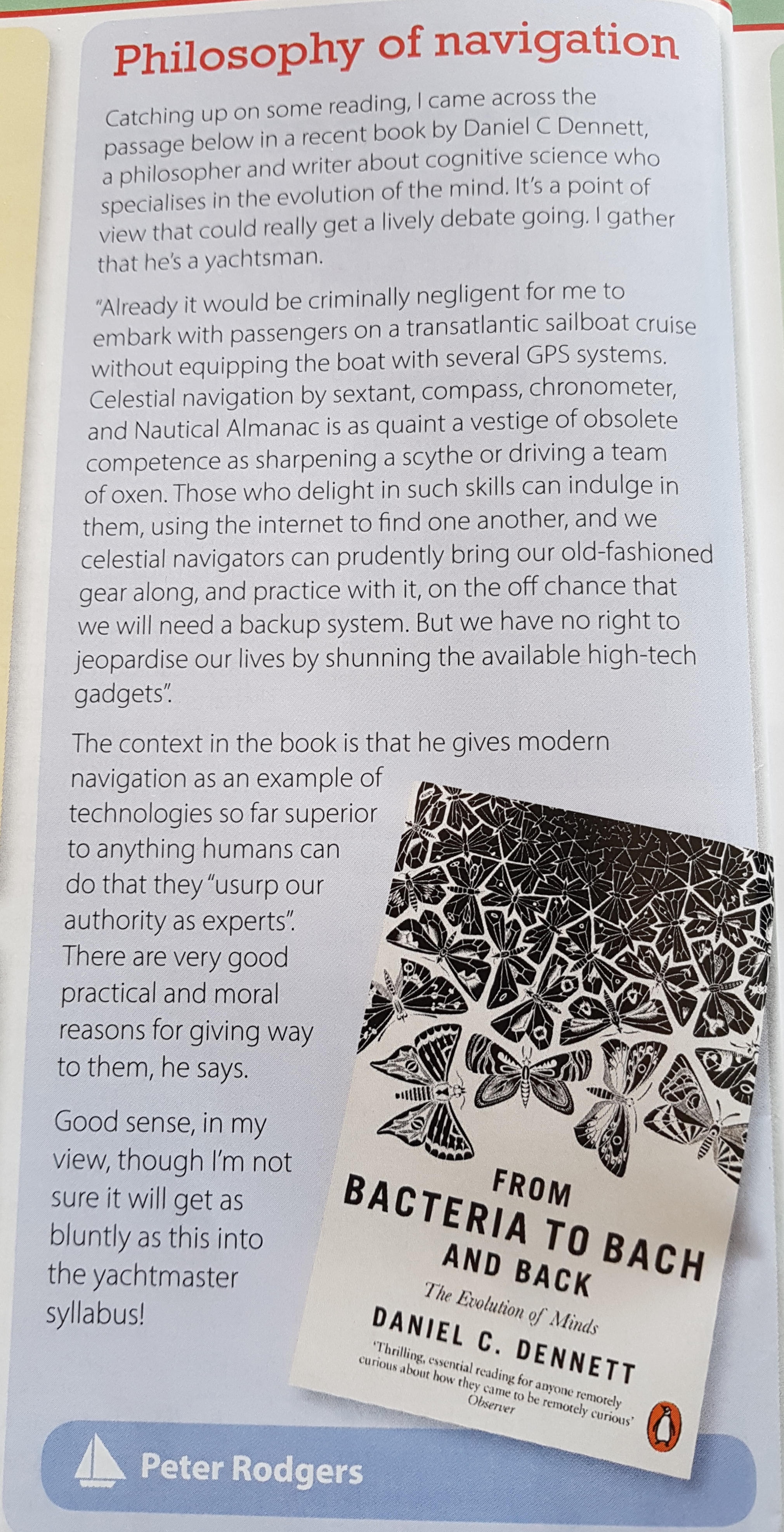
Two letters in the latest issue of the excellent Cruising Association magazine* claim it is now safe to rely entirely on electronic charts because backups to the boat’s main chartplotter are so cheaply available. You can leave your old paper charts abandoned in the bottom of a locker somewhere, the argument goes.

However, while researching updates for the yachtmaster book I mentioned last month, I’ve been re-reading intensively about old fashioned navigation techniques I learnt a long time ago, some of which were beginning to fade from memory. It has reinforced for me how important it is to avoid total reliance on electronics and have a portfolio of navigation skills including the old ones. Continue reading “Relearning old navigation lessons”

January – satellite scares, and getting ready for Biscay

At the Royal Institute of Navigation’s small boat conference in Lymington earlier this month, I learnt a lot about  new risks of error  in satellite navigation : I did not know, for example, that it is possible with quite cheap local equipment to fool the GPS on a plane, ship or even a missile into thinking it is somewhere other than its real position.

There are now tens of thousands of reported incidents of errors, deliberate, accidental or of unknown cause, with a substantial number of them unsurprisingly in sensitive areas such as the Gulf, and the Black Sea near Ukraine, suspected to be hostile activity.

Reports of accidental errors include a couple of local failures when US naval vessels arrived in the port of San Diego, apparently forgetting to switch off unspecified electronic equipment, which interfered with satellite-derived positions for miles around.

Continue reading “January – satellite scares, and getting ready for Biscay”

Hard Brexit and boat VAT – Treasury response

The Treasury has finally decided that if a yacht is in the European Union on Brexit day, it will not be liable for VAT if it is brought back to the UK later.

As reported before, the Commission said recently that British yachts would lose their EU VAT-paid status unless they were in the EU on the day of a hard Brexit.

If they were in the UK they would no longer have the status of union goods and would be liable for VAT on visiting the EU, so the best they could do would be to apply for temporary importation for up to 18 months. Continue reading “Hard Brexit and boat VAT – Treasury response”

Bang goes our EU status

It has now been confirmed that we will lose our boat’s VAT-paid status in Europe on Brexit day, leaving us with only the possibility of a temporary importation licence for up to 18 months.

Only British boats actually kept in the EU on that day will be treated as if the VAT paid on them in the UK is still European VAT. If they are in the UK on Brexit day, then they lose that ‘union goods’ status and can only apply for temporary importation.

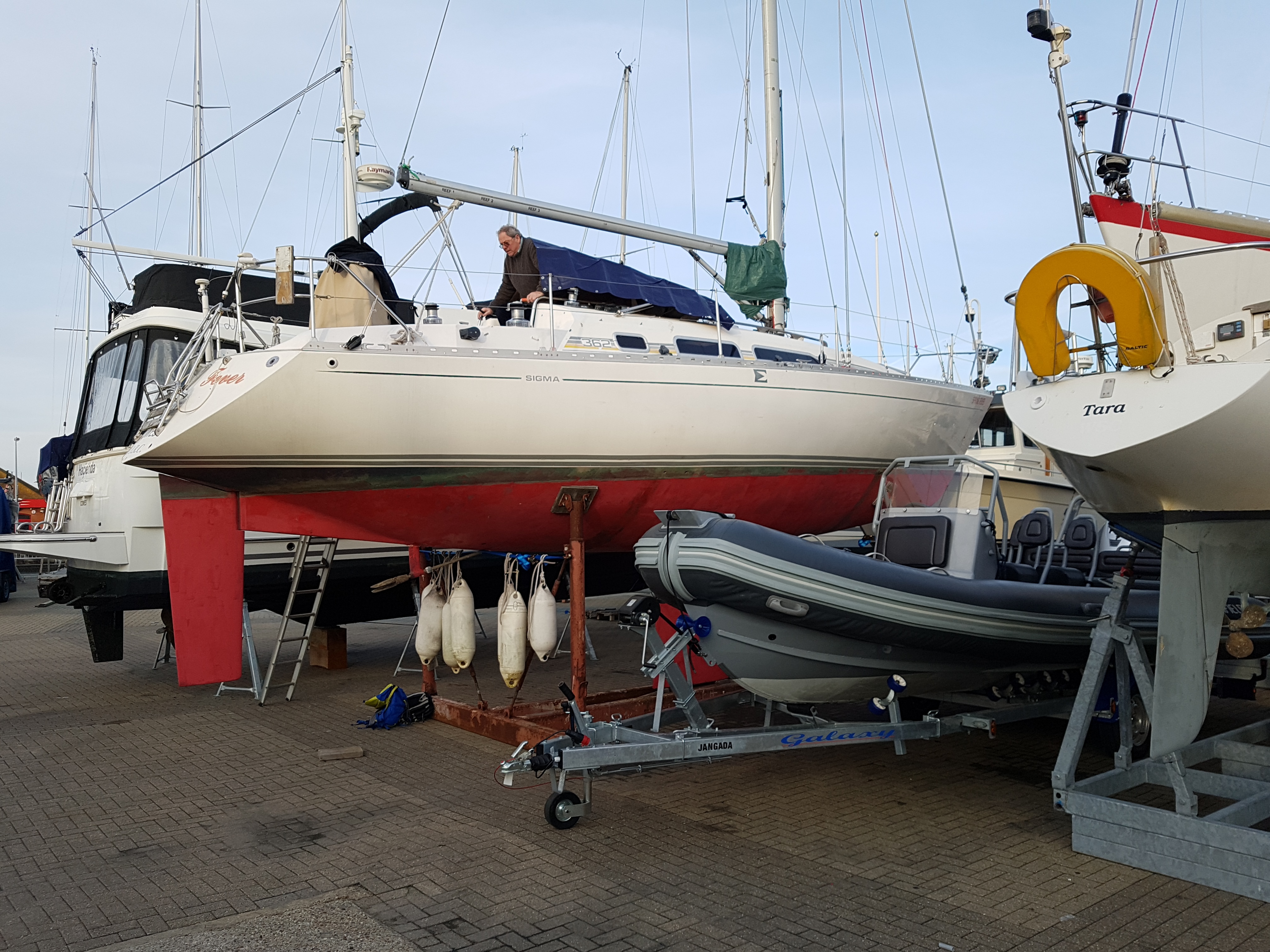
Spring Fever in Cowes, awaiting a new engine

Continue reading “Bang goes our EU status”

Brexit and our boat

We’ve been looking into the impact of Brexit on our sailing, on the assumption that at some point we will be treated as a third country, just like US and Canadian sailors who cross the Atlantic to visit the EU. If there is a hard Brexit at the end of March, this could all be upon us next season. The result is likely to be a long term increase in paperwork and bureaucracy and a permanent annoyance for British yacht owners.

Even as EU members we have not been bureaucracy free. Because the UK is outside the Schengen zone, we have been obliged in theory to show our passports on arrival, though some Schengen countries such as France often do not bother to enforce passport checks on yachts. (That might be changing, because in July, for the first time in many years, we were boarded on a mooring by French customs officers in a RIB, whose only interest was in our passports).

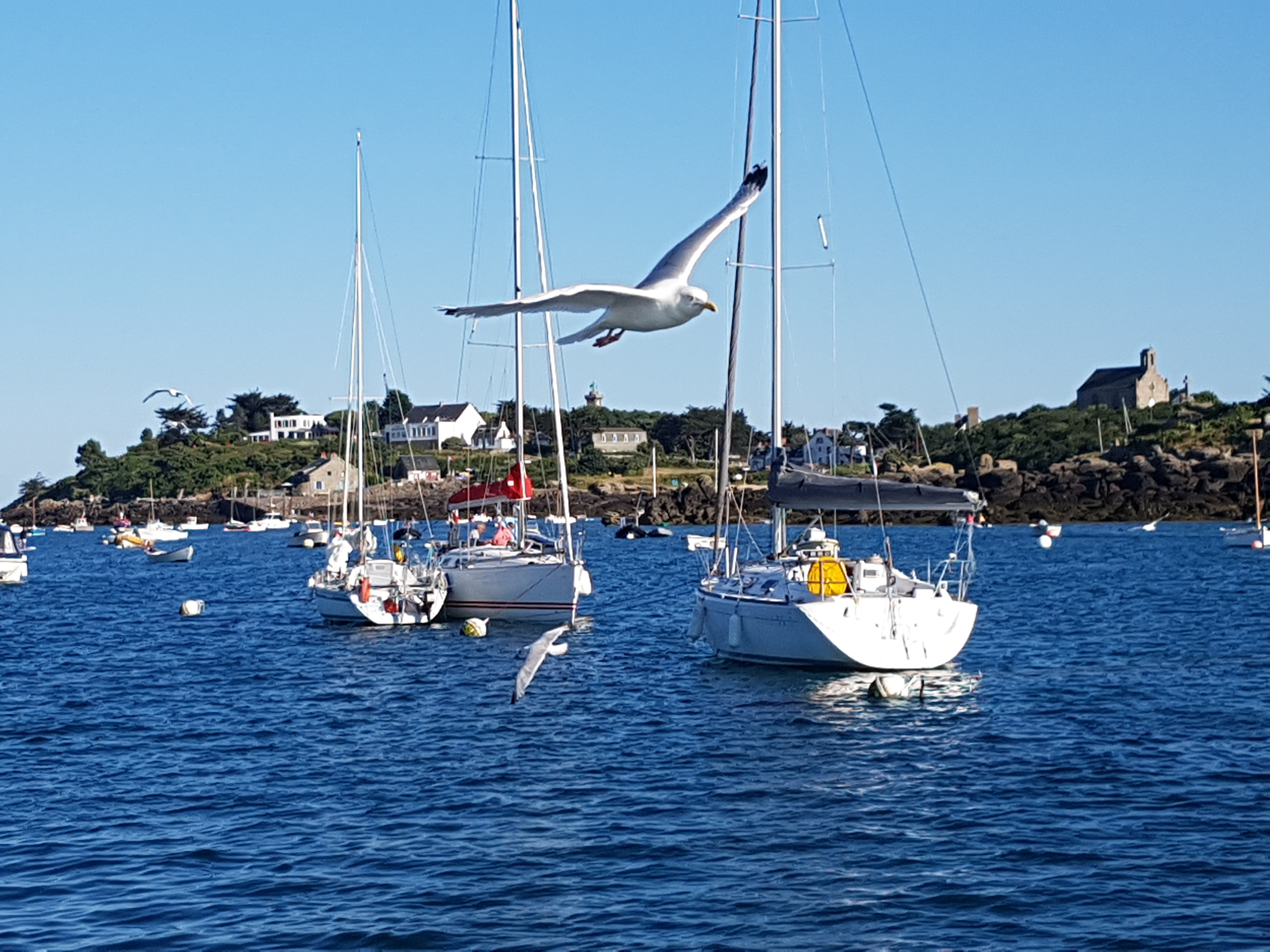
View from our mooring at Îles Chausey, where we were boarded by French customs.

Continue reading “Brexit and our boat”

Race fleets hogging marinas

Three times on our cruise to southern Brittany we were turfed out of marinas and harbours because of race fleets: at Torquay Marina, where we arrived just before dawn, we were ejected as soon as staff arrived because the marina was fully booked for a Figaro single-handed race; at Port Tudy, on the Ile de Groix, we were turned away for the another race fleet; and at L’Aber Wrac’h we were refused a second day when we  wanted to stay, because a 120 strong race fleet was arriving that afternoon, which was going to more than fill the marina. Each of these fleets were closing a succession of ports, day by day over anything up to a week. With L’Aber Wrac’h in particular, there isn’t anywhere convenient near, and tired arrivals that day from Falmouth or Dartmouth must have been furious, since it is the standard stopover when heading to the Chenal du Four.

It would be great to find a way of broadcasting the information about closures more widely: maybe something for Reeds Almanac or the Cruising Association to pursue?

Salen to Puilladobhrain and Oban

We had planned to go from Arisaig or perhaps Canna round the West of Mull to Iona, past Staff and Fingal’s Cave, but the weather was doubtful for the exposed anchorages on that side of the island so we decided to head back down the Sound of Mull again and maybe make a dash for Iona from the other direction the following day. However, half way down Tony had a call to go home to deal with a family emergency, so we diverted to Oban, first stopping at one of the best known anchorages on the Argyll coast, the tiny, tucked away Puilladobhrain.

This is the point to mention the excellent large scale charts produced of West of Scotland anchorages by Bill Bradfield using his own new surveys. Judging by a talk he gave to the Cruising Association in London in February, amateur surveying has become a passion with him, and he must now be very close to being a full professional judging by the quality of what he produces. His charts come with lots of health warnings, but we found them very accurate the dozen or so times we used them. They are available from Antares Charts.

Continue reading “Salen to Puilladobhrain and Oban”

Med charter disaster?

Since looking into chart accuracy following the Orkney cruise (see previous article) I’ve spent a couple of months in the Mediterranean. It’s much worse there.

I vaguely knew that, but previous sailing in the Mediterranean had been without chartplotters and on the earliest occasions without GPS. More recently, chartplotters seem to be standard on charter boats as well as private yachts. We amused ourselves by doing some checking. Continue reading “Med charter disaster?”