The near-universal shift by small boat sailors from paper to electronic charts has left the Royal Yachting Association’s training courses floundering in recent years.
That was underlined when Admiralty, owned by the UK Hydrographic Office and one of the world’s gold standard official chart brands, said in July that it will stop selling paper charts altogether by the end of 2026.
Every river I know with saltings has timber rubbish stranded near the high tide line, usually broken and ignored. A close look, however, tells a better story. Today’s flotsam is often a fragment of a very old boat, and the best of all is a piece of long-lasting teak.
Covid caused a full week’s delay in Ireland, and the weather forecast added another three days. By then we were feeling fit, though perhaps tiring a touch more easily than usual. We grabbed the chance to see more of Dublin, along with Rob, who arrived by ferry late on Sunday night.
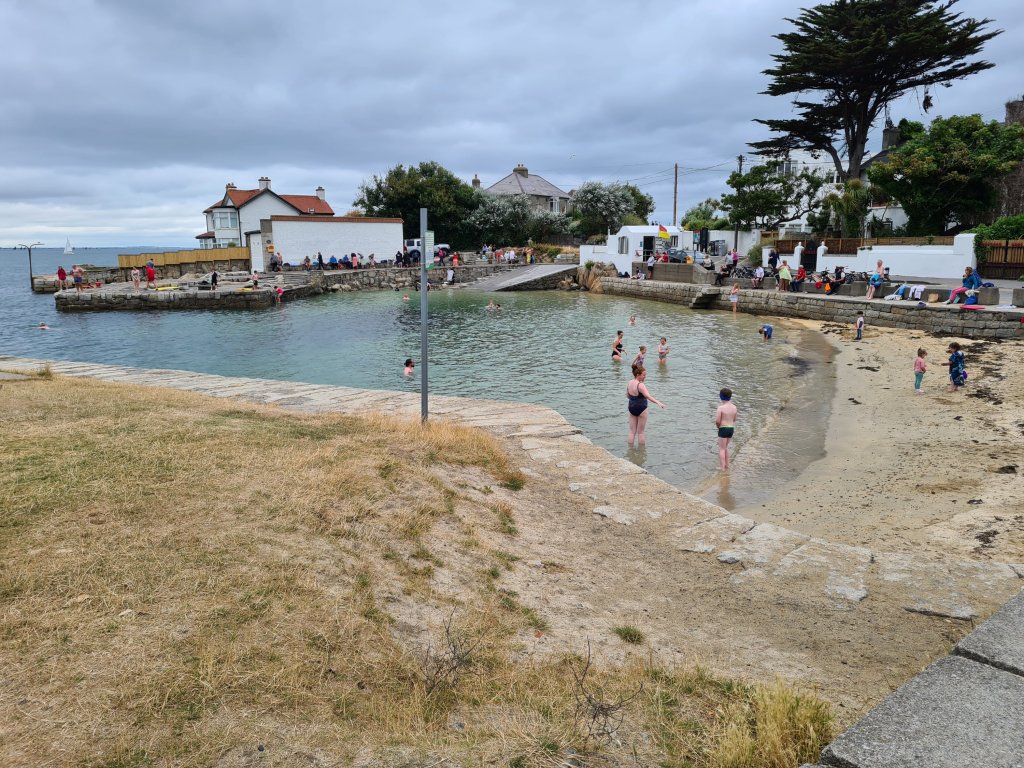
Sandy Cove, Joyce’s Tower almost hidden behind the trees on the right
Near Dun Laoghaire, the James Joyce Tower and Museum at Sandy Cove is fascinating both for its atmosphere and – at weekends – for the fluent storytelling about Joyce and Ulysses by the volunteers who staff it. The tower is the setting of the first page of the book.
The plan before Covid struck was to allow three weeks for a cruise to the Irish Sea, which is quite difficult to time exactly because of the uncertainties involved in rounding Lands End.
To make the new cruise work on our original pre-Covid timescale, Tony and I had taken advantage of a generous offer from Antony F to arrange a mooring for us at Saltash Sailing Club, an attractive and friendly place near the Tamar bridges (see June post).
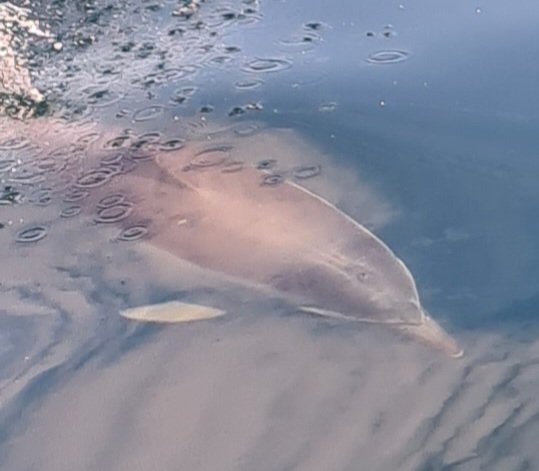
Dolphins all the way from Plymouth to Helford – here’s one about to surface
A good wind to get to Lands End from Plymouth is often a bad wind for carrying on northwards to Ireland. Strong winds can also prevent rounding the headland for days, as we found in 2007 when we were held up for a week in Falmouth.
It was a lovely cruise to Ireland at first, with fine, sunny weather rather than the extraordinarily high temperatures that hit central and southern England. But half way through we had a problem for which there was no easy answer – three of us tested positive for Covid after feeling as if we were getting mild colds, with headache, sinusitis and sore throat.
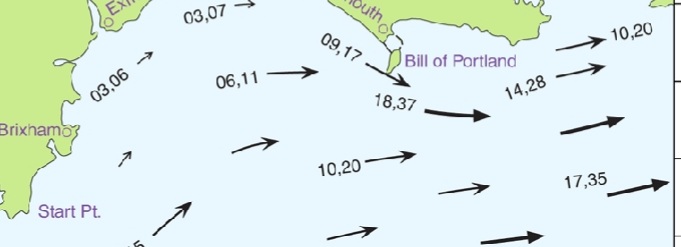
With half a dozen tidal gates on a passage from the Solent round Lands End, we managed to get through four of them in 24 hours last week. The westerlies that usually slow a cruise to Devon and Cornwall gave way to light winds from between north and east, with calm seas.
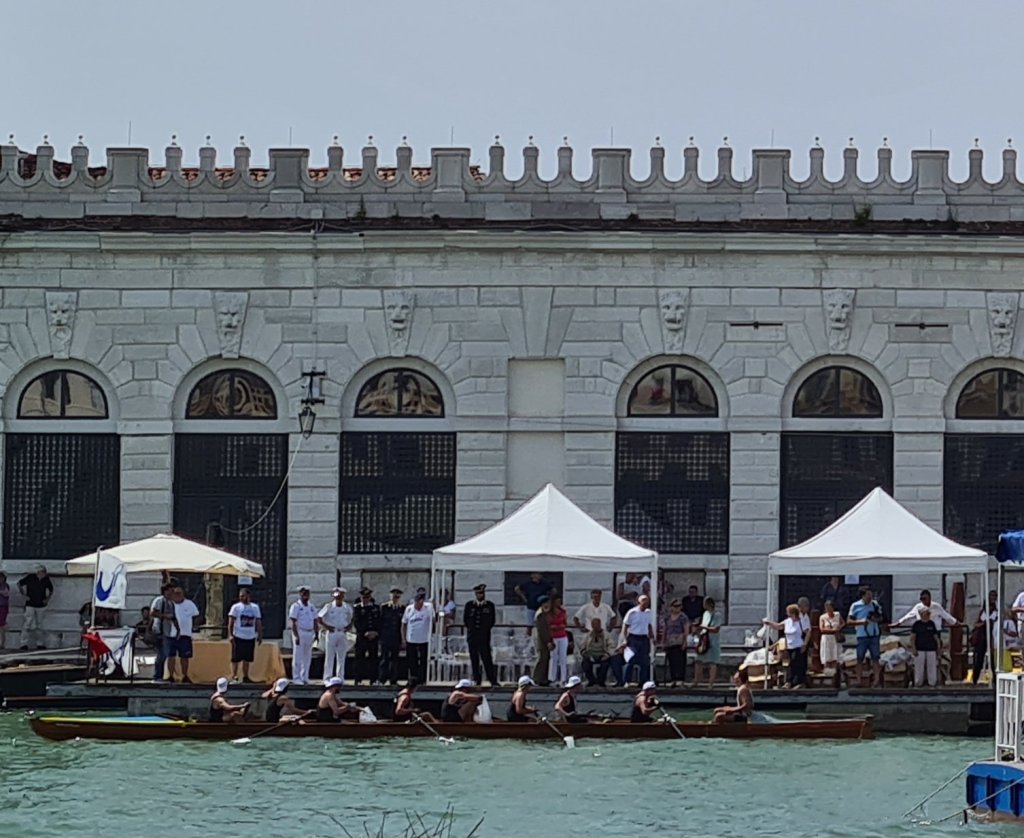
The first boat to appear at the Dogana on the Grand Canal after the 30 km Vogalonga rally round the lagoon and canals of Venice was a coxed eight. It was another 40 minutes before the arrival of the first of the traditional Venetian boats, the ones everyone really wants to see.
All the boats finished further up, beyond the Rialto, and they then paraded down to the official pontoon at the Dogana, which is at the entrance to the Canal.
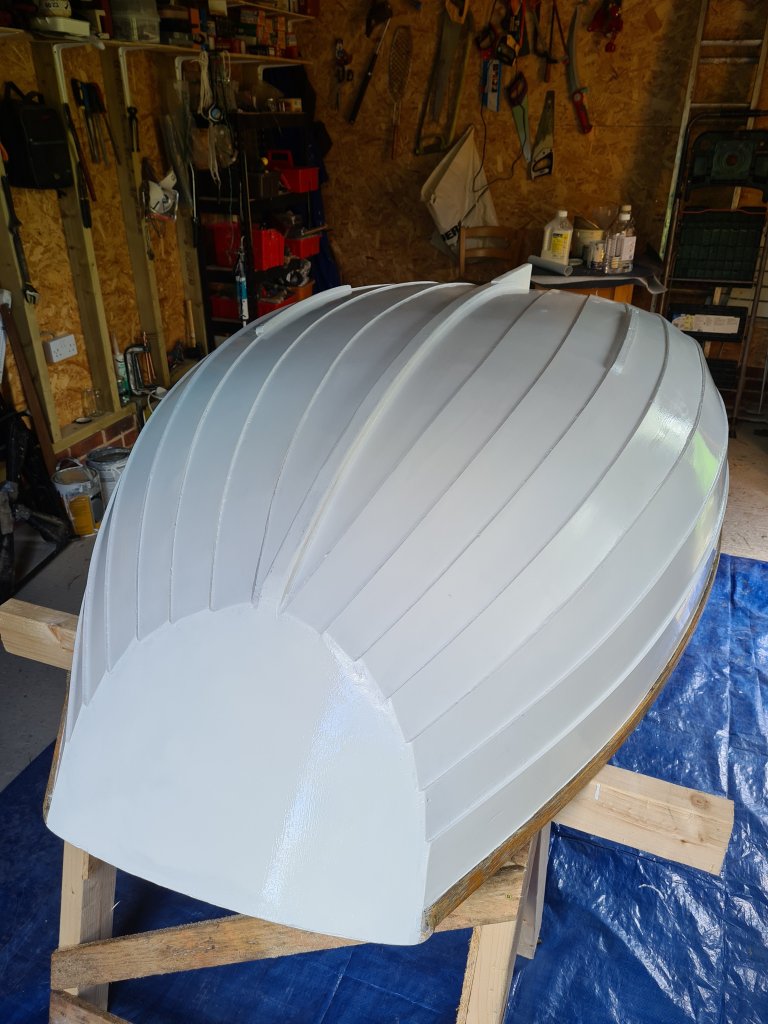
After 8 years kept in the open, the Iain Oughtred feather pram finally needed its paint refreshed.
The Hempel all in one primer, undercoat and topcoat lasted amazingly well. The boat is stored upside down in the garden when not in use, and only had a tarpaulin over it in the winter.
First coat drying
We gave the hull a rub down with fine 600 grade wet and dry, then washed it and left it for 24 hours to dry before the first coat.There was enough paint left in the old pot for a full coat this time, to be followed by two coats of gloss.
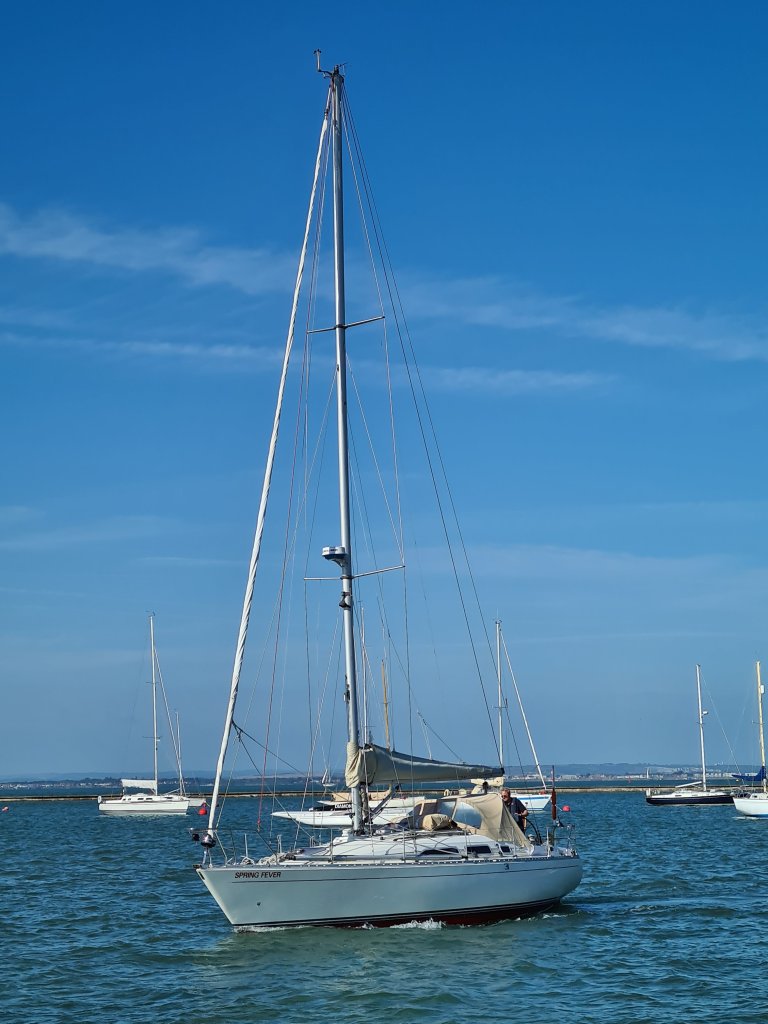
We finally launched Spring Fever at the end of April, though not without hiccups, because the crane needed to put the mast up broke down.
On the way in, without a mast
We launched the boat mastless anyway, and used the time to collect a new cooker – the gas survey for our insurers had brought the expensive news that the cooker was condemned for corrosion and age.
Luckily there was one available at the marina near Newport, Island Harbour, so we chugged up there to collect it, and the gas engineer came to fit it the next day.
The boatyard where we wintered at Kingston managed to hire in a crane. so we went back there. The mast was put up three days late by a very efficient and patient team from Spencers of Cowes, which had made our new standing rigging. Spencers replaced the rigging last time we did it as well, in 2009.
Apart from that, we had the usual long list of bits and pieces to do to commission the boat, but because of the delays we had no time for a trial sail.
Just finished another updating project, this time of David Fairhall’s Pass Your Day Skipper, with cartoons by the late Mike Peyton. It will be published in the New Year. My update of Pass Your Yachtmaster was published last year.
Insurance surveys don’t come round very often, but it’s a finger chewing time when they do. What’s going to be found and how much will it cost?
We’ve been lucky with our insurers, who haven’t insisted on a survey since we bought Spring Fever in 2009. Our current insurers gave us a year’s notice that we’d need one this winter.
The survey has just been completed by Adrian Stone of Cowes. The good news is that the main work needed is a job we have been contemplating anyway, which is replacing the standing rigging.
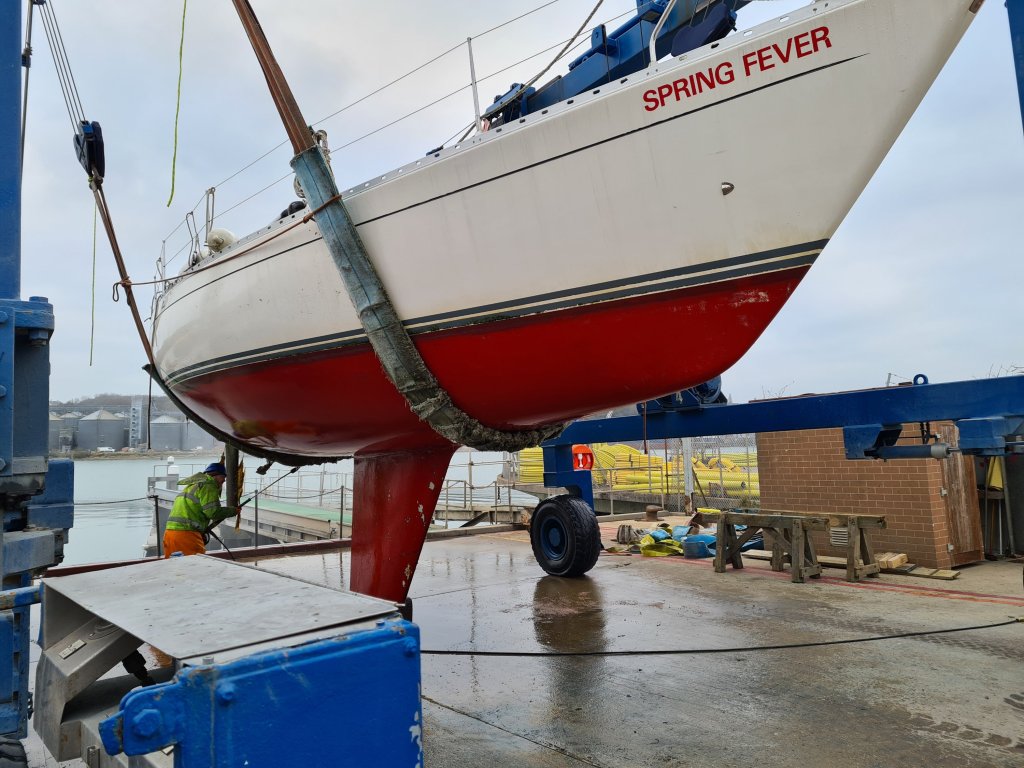
Out of the water and pressure scrubbed.
It still looks acceptable on close inspection, but one of the risks with stainless wire and fittings is sudden failure, as likely from a hidden crack in a steel piece as from the wire itself. Some insurers are said to ask for replacement every 10 years but our standing rigging has lasted a full 13 seasons.
The small craft navigation conference in Cowes at the end of January heard that the RYA is finally promising to overhaul its outdated Day Skipper and Yachtmaster shore-based courses.
The conference was also told that there is to be a concerted attempt to abolish that annoying legal disclaimer on all our electronic charts that they are “not for navigation.” As soon as we switch on a pop-up appears with this message, often with a line underneath saying that only paper charts must be used, which of course almost everybody ignores.
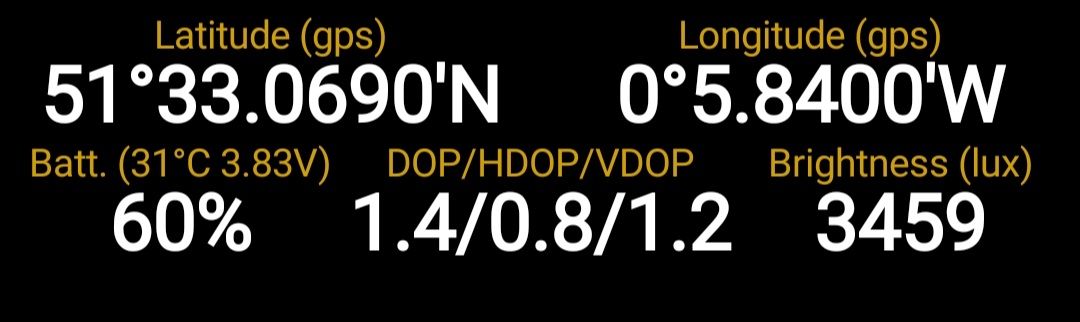
It seems that while my phone is accurate to an error of considerably less than 10 metres, the industry is heading to even better precision of a tenth of that level, and soon. This post looks at why that means satellite accuracy on all devices including smartphones is reaching levels where there are diminishing returns for small boat sailors.
In general, 5 metre satellite accuracy has been available on smartphones for a considerable time now. I give links at the end to industry, US government, academic and consumer articles that give more detail on how accuracy has been developing (and see also my earlier post ‘and a phone to steer her by’).
One of the secrets of the top performers such as the high-end Samsung phones, which can achieve 2 metres, is that they now have dual frequency satellite aerials so they can make the best use of the latest improvements not only in the US GPS, but the Russian Glonass, European Galileo and Chinese Beidou satellite systems. Nowadays, phones will often have as many as 40 satellites in the sky from which to choose the best signals.
It’s sad to read happy accounts of a peaceful sailing season just before the worst storm ever unleashed on Europe – by which I mean World War II, not the weather.
I’ve been leafing through the 1938-9 Yachtsman’s Annual, picked up for a few pounds the other day in an Oxfam bookshop. It’s not just the handsome young people in bright sunshine helming racing dinghies, who we know might soon be in mortal danger on the front line in a war. It’s also the international cruises and races, some of them to Germany, with skippers and crews displaying no public awareness (whatever they privately thought) of what was happening in the world around them.
Mobiles have had a bad press as navigational tools, but if I were forced to choose one single piece of electronics to take to sea it would be my phone. That’s not a popular view among professionals.
Instructors, coastguards and rescue services learn of many cases where boat owners, especially of powerful motor yachts and RIBs, set off for the open sea with nothing beyond a chart app on a mobile phone, and no knowledge of the underlying skills needed to navigate safely. For the Royal Yachting Association, mobiles are well down the list of recommended priorities, because of the risk that they will be used badly. Textbooks give stern warnings that you must not use them for navigation.







 tide by tide