How to cope without paper charts

UPDATE APRIL 2025

After centuries of printed maritime chart publication in the UK, the options are shrinking rapidly. Until this month it looked as if they would all soon be gone after Imray said it was ending paper chart production – though there is now a reprieve after the announcement of a joint venture with the Austrian cartographers Freytag & Berndt.

Good luck to them, and let’s hope it succeeds. But the precariousness of the paper chart business suggests that a wise owner should still prepare now for entirely electronic navigation.

Luckily small craft can learn a lot from the all-electronic bridges of big ships, which have been paperless for years. That seems to be where we are all headed in the next few years whatever happens to paper charts, which for most people I know are now relegated to passage planning and rarely updated.

I’ve collected and updated material from previous posts in a new note, because events have been moving rather fast.

Here is a link to the note.

RYA navigators still last in the fleet

November 2024 update: This month Imray announced that it is ending paper chart publication at the end of next year, which makes the RYA’s paper focused training look more out of touch than ever. With Imray charts gone and the Admiralty ending paper chart publication in 2030, it will be electronics only in the UK.

Sometimes I wonder where the Royal Yachting Association has been for the last 10 years. I have just had an email from them saying “in the next ten years or so digital will become the dominant method of navigation”. In the real world of small boats, digital has been the dominant method of navigation for at least the last 10 years.

Continue reading “RYA navigators still last in the fleet”

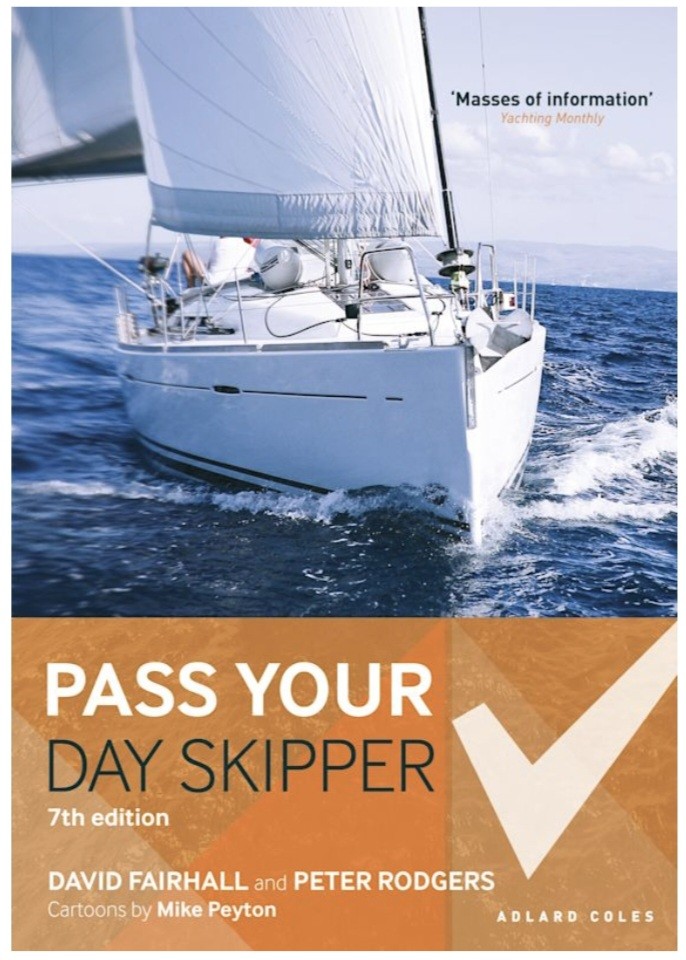
Just out – the new Pass Your Day Skipper

The new edition of Pass Your Day Skipper by David Fairhall and Peter Rodgers is now on sale. The book was originally by David but – at his invitation – I’ve expanded it and added lots of new material on electronic navigation, weather, and safety. The illustrations are by the famous sailing cartoonist Mike Peyton.

Continue reading “Just out – the new Pass Your Day Skipper”

Another Admiralty problem

What I didn’t realise when I wrote the recent post on the UKHO delaying the end of Admiralty paper charts was that there was a sting in the tail – they had wanted to drop raster electronic charts as well. That has also been delayed a few years to 2030 while they think about it.

Continue reading “Another Admiralty problem”

Admiralty gives in

The revolution has been postponed: the United Kingdom Hydrographic Office has delayed the phasing out of its Admiralty paper charts for four years, to 2030. This follows pressure from the Royal Yachting Association and others.

The argument against losing paper charts sooner is that adequate electronic alternatives for small craft – especially small commercial ones – will not be ready in time.

Continue reading “Admiralty gives in”

Wrong-headed satellite precision claims

I’ve had quite a few emails recently from Orca, a navigation equipment and software firm, boasting about the 3 metre location accuracy of their equipment as a major selling point. It’s a waste of marketing effort, as far as I’m concerned.

Three metre satellite accuracy – available nowadays even on some top of the range phones – is no use when round much of the British Isles chart positions can be far less accurate.

Continue reading “Wrong-headed satellite precision claims”

RYA electronic chart training has missed the boat

The near-universal shift by small boat sailors from paper to electronic charts has left the Royal Yachting Association’s training courses floundering in recent years.

That was underlined when Admiralty, owned by the UK Hydrographic Office and one of the world’s gold standard official chart brands, said in July that it will stop selling paper charts altogether by the end of 2026.

Continue reading “RYA electronic chart training has missed the boat”

January – RYA training upheaval, and ending an electronic chart nonsense

The small craft navigation conference in Cowes at the end of January heard that the RYA is finally promising to overhaul its outdated Day Skipper and Yachtmaster shore-based courses.

The conference was also told that there is to be a concerted attempt to abolish that annoying legal disclaimer on all our electronic charts that they are “not for navigation.”  As soon as we switch on a pop-up appears with this message, often with a line underneath saying that only paper charts must be used, which of course almost everybody ignores.

Continue reading “January – RYA training upheaval, and ending an electronic chart nonsense”

Coming soon on your phone – one metre accuracy

It seems that while my phone is accurate to an error of considerably less than 10 metres, the industry is heading to even better precision of a tenth of that level, and soon. This post looks at why that means satellite accuracy on all devices including smartphones is reaching levels where there are diminishing returns for small boat sailors.

In general, 5 metre satellite accuracy has been available on smartphones for a considerable time now. I give links at the end to industry, US government, academic and consumer articles that give more detail on how accuracy has been developing  (and see also my earlier post ‘and a phone to steer her by’).

One of the secrets of the top performers such as the high-end Samsung phones, which can achieve 2 metres, is that they now have dual frequency satellite aerials so they can make the best use of the latest improvements not only in the US GPS, but the Russian Glonass, European Galileo and Chinese Beidou satellite systems. Nowadays, phones will often have as many as 40 satellites in the sky from which to choose the best signals.

Continue reading “Coming soon on your phone – one metre accuracy”

…and a phone to steer her by

Mobiles have had a bad press as navigational tools, but if I were forced to choose one single piece of electronics to take to sea it would be my phone. That’s not a popular view among professionals.

Instructors, coastguards and rescue services learn of many cases where boat owners, especially of powerful motor yachts and RIBs, set off for the open sea with nothing beyond a chart app on a mobile phone, and no knowledge of the underlying skills needed to navigate safely. For the Royal Yachting Association, mobiles are well down the list of recommended priorities, because of the risk that they will be used badly. Textbooks give stern warnings that you must not use them for navigation.

Continue reading “…and a phone to steer her by”

Back to the future – electronics on board

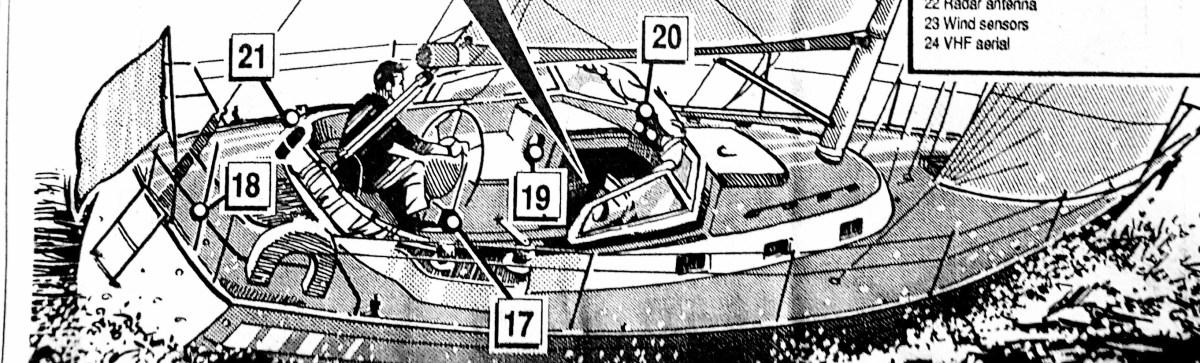
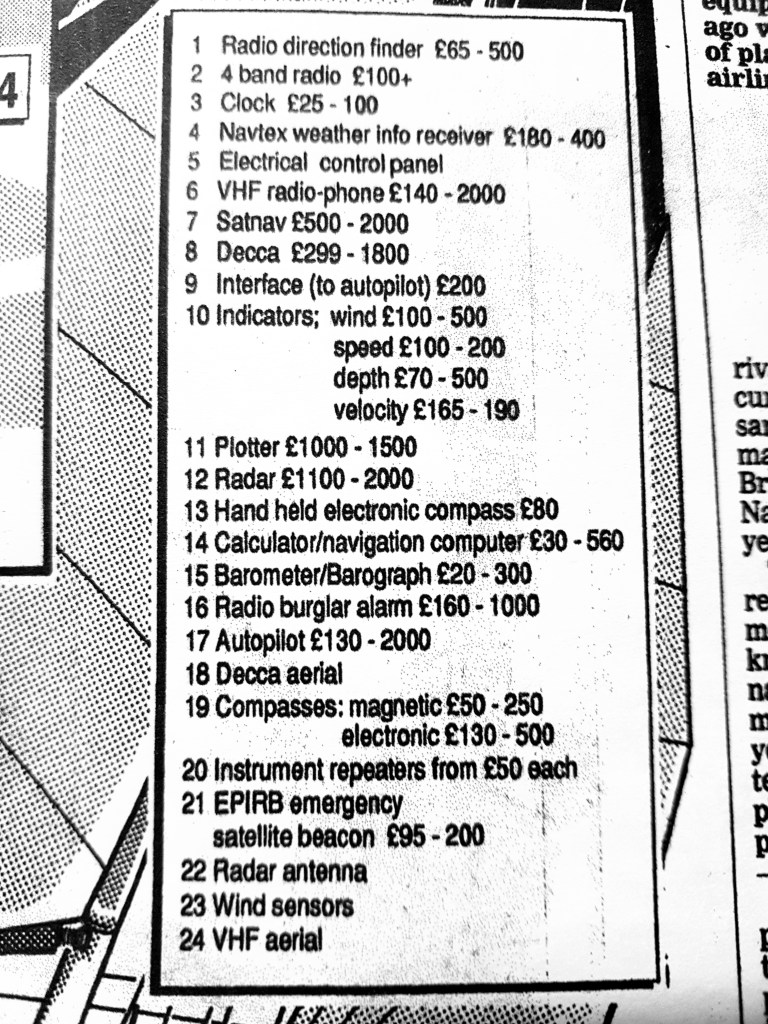
I was intrigued by the equipment list below, which is more than three decades old, because it was a reminder of how long we have been arguing about the risks and rewards of electronic navigation. I found the list in some old files I was checking last year for the sixth edition of Pass Your Yachtmaster by David Fairhall and Mike Peyton, which I was commissioned to update by Adlard Coles*.

A 1989 list of yacht electronics talked about at the Boat Show

The list was part of an article I produced for the Guardian newspaper about electronics for small boat navigation, under the headline ‘And a satellite to steer her by’, researched by talking to manufacturers due to appear at that year’s London Boat Show. I had forgotten all about it.

Continue reading “Back to the future – electronics on board”

Satellite accuracy on a mobile

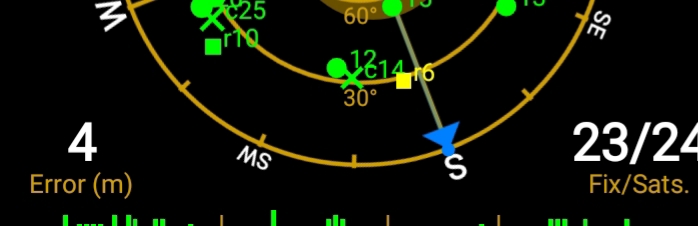
How accurate is the position calculated by your smartphone? The Royal Institute of Navigation is sceptical. Its new book on electronic navigation for leisure sailors says: “At sea, mobile phone positioning uncertainty will typically be several hundred meters or more, which may be enough to put us into danger”.

I am looking for some proper studies on this issue, because I am sceptical about that statement. In the meantime it’s easy to check what your phone tells you about its own location performance when it relies only on satellite signals.

Continue reading “Satellite accuracy on a mobile”

Relearning old navigation lessons

Two letters in the latest issue of the excellent Cruising Association magazine* claim it is now safe to rely entirely on electronic charts because backups to the boat’s main chartplotter are so cheaply available. You can leave your old paper charts abandoned in the bottom of a locker somewhere, the argument goes.

However, while researching updates for the yachtmaster book I mentioned last month, I’ve been re-reading intensively about old fashioned navigation techniques I learnt a long time ago, some of which were beginning to fade from memory. It has reinforced for me how important it is to avoid total reliance on electronics and have a portfolio of navigation skills including the old ones. Continue reading “Relearning old navigation lessons”

February – averting satellite disaster

The British government turns out to have been ahead of the game on the  satellite risks I mentioned last month, with a £36 million programme just announced to  prevent navigational satellite failures damaging the economy by as much as £1 billion a day. It is feared that the entire country has become over-dependent on a handful of satellite systems.

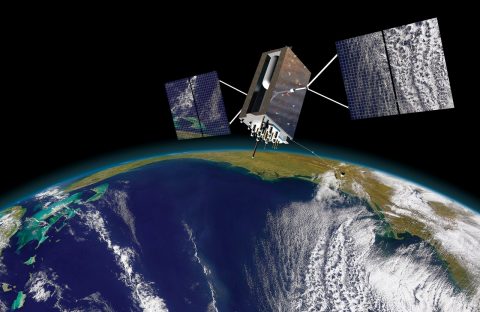
Emergency services, the energy grid, mobile phones, Satnav, broadcasting and other communications, the Stock Exchange and an array of other activities all rely heavily on the super-accurate timing provided now by navigational satellites such as GPS and similar systems. There are life-threatening risks from failure, says the government.An image of a third generation Lockheed Martin GPS satellite

The new investment is in a National Timing Centre to create a network of super-accurate atomic clocks around the UK, accessed through ground-based communications, so that the economy will no longer be over-reliant on timing from GNSS signals from the sky.

GNSS is the term that embraces the US  GPS, the first system, Russia’s GLONASS satellites, Europe’s new Galileo and also a rapidly developing Chinese system.

Galileo failed completely for a while last year during its start up phase, because of operator errors, and there are now many examples of interference with GNSS systems and malicious ‘spoofing’, in which navigation instruments are fooled into thinking they are somewhere else. The heart of all navigation by satellite is accurate timing, without which positions cannot be fixed.

Continue reading “February – averting satellite disaster”

January – satellite scares, and getting ready for Biscay

At the Royal Institute of Navigation’s small boat conference in Lymington earlier this month, I learnt a lot about  new risks of error  in satellite navigation : I did not know, for example, that it is possible with quite cheap local equipment to fool the GPS on a plane, ship or even a missile into thinking it is somewhere other than its real position.

There are now tens of thousands of reported incidents of errors, deliberate, accidental or of unknown cause, with a substantial number of them unsurprisingly in sensitive areas such as the Gulf, and the Black Sea near Ukraine, suspected to be hostile activity.

Reports of accidental errors include a couple of local failures when US naval vessels arrived in the port of San Diego, apparently forgetting to switch off unspecified electronic equipment, which interfered with satellite-derived positions for miles around.

Continue reading “January – satellite scares, and getting ready for Biscay”